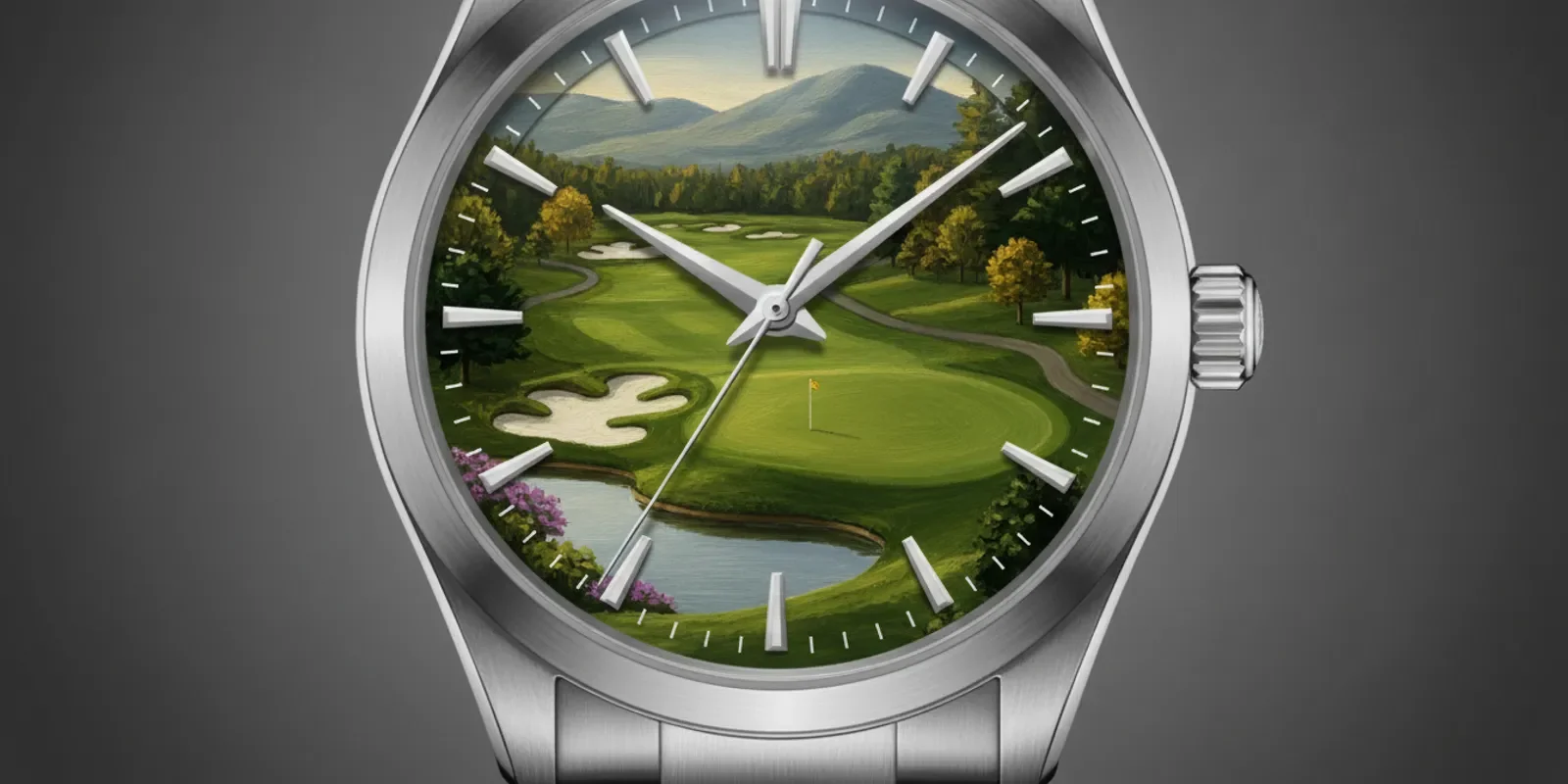
When a watch listing says it has a sapphire crystal, it is describing the clear cover over the dial, not the movement that powers the watch. So what is sapphire crystal on an automatic watch, and what does that phrase tell you as a buyer? It usually means the dial is protected by a transparent material made from synthetic sapphire, selected for its resistance to everyday scratching and its clear view of the display. It does not mean the crystal cannot break, that the watch is waterproof, or that every sapphire crystal looks and performs exactly the same.
Call with a question about the watch
What does “sapphire crystal” mean on a watch?
A watch crystal is the transparent cover that sits above the dial. It separates the dial and hands from dust, fingerprints, and contact with objects during ordinary handling. The word “crystal” is a traditional watch term; it does not mean that the cover is a natural gemstone cut for use as a window. In contemporary watchmaking, sapphire watch crystals are generally manufactured from synthetic sapphire, a crystalline form of aluminum oxide.
Synthetic sapphire is chemically the same basic material as natural sapphire, but a watch crystal is engineered for its job. It is grown and cut into a clear, shaped component. It is not the same as a blue or red sapphire used in jewelry, and it does not need to have a gemstone’s color. The finished watch crystal is intended to be transparent so that the wearer can read the dial.
The term also does not tell you the dimensions or construction of the crystal. It may be flat or curved, and it may sit above the bezel or be shaped to fit within it. The product description may identify a coating as well. Those details affect the appearance, reflections, and fit, but the word sapphire by itself does not specify them.
For an automatic watch, the crystal is separate from the movement. “Automatic” describes a mechanical movement that winds itself as the watch is worn, through the motion of the wrist and a rotor inside the case. Sapphire describes the dial-cover material. A watch can have a sapphire crystal with an automatic movement, a quartz movement, or another kind of movement. The two terms answer different questions.
Why do watchmakers use sapphire?
The main practical reason is hardness. Synthetic sapphire is very resistant to scratching compared with many common watch-cover materials. A crystal that stays clear helps preserve a readable dial and the appearance of the watch. This can matter especially when the dial itself is an important part of the object, such as a watch with detailed artwork, textured markers, or fine hands.
Hardness is not the same as toughness. Hardness describes resistance to being scratched or indented by another material. Toughness describes how well a material resists cracking or breaking when struck or stressed. Sapphire is hard, but it can chip or fracture under a sufficiently forceful impact. A scratch-resistant crystal is not an indestructible crystal.
Sapphire can also provide a clean, bright view of the dial. Some crystals have anti-reflective treatment to reduce glare. The treatment may be on the inside, outside, or both surfaces, depending on the watch design. A listing that says a coating is on the inside is giving more specific information than a listing that simply says “anti-reflective.” If coating placement matters to you, check the stated specification rather than assuming it.
These benefits come with trade-offs. Sapphire components can cost more to produce and replace than simpler materials. A scratch-resistant surface may still be damaged by a hard impact, and some coatings may show marks that can be mistaken for damage to the underlying crystal. For buying decisions, think of sapphire as one useful part of the watch, not as a complete measure of quality.
How does sapphire compare with mineral glass?
Mineral glass is another common watch-crystal material. It is a glass material, sometimes treated or hardened to improve its resistance to damage. In broad terms, sapphire is usually much more resistant to scratching, while mineral glass may respond differently to impacts and may be less expensive to replace. The actual result depends on the material, its treatment, crystal shape, thickness, case design, and the kind of contact involved.
There is no simple rule that one material is best for every wearer. A person who is especially concerned about small scratches on a watch worn often may prefer sapphire. Someone prioritizing a lower repair cost or a particular design may weigh the trade-offs differently. Neither material removes the need to treat a watch carefully.
Watch listings are not always precise about material names. “Glass,” “crystal,” and “mineral crystal” may be used differently across product descriptions. If a listing does not say which material covers the dial, ask the seller for the specification. Do not infer sapphire from a high price, a luxury appearance, or the fact that the movement is automatic.
When comparing two watches, record the exact wording in each listing. Note whether the seller identifies the crystal material, whether a coating is specified, and whether the shape is described. If one listing only says “crystal” and another says “sapphire,” the second gives a clearer answer about material, but it still does not prove anything about water resistance, impact performance, or service support.
Is sapphire crystal scratch-proof?
No. “Scratch-resistant” is a more accurate everyday description than “scratch-proof.” Sapphire is highly resistant to many ordinary scratches, but no watch crystal should be treated as immune to every mark or impact. Hard materials can still damage one another, and a sharp blow can chip or crack a crystal even if the surface itself has not been scratched.
A mark on the watch may also be on a coating rather than in the sapphire beneath it. Anti-reflective coatings are thin treatments that change how light reflects from a surface. If a watch has a coating on its outside, contact may mark that coating even when the crystal material underneath is undamaged. An internal coating is less exposed to direct contact, though its exact role and performance depend on the design.
If you see a new line, spot, or haze, do not immediately try to polish it with household products. First, view the watch in indirect light and change the angle. A reflection, fingerprint, residue, coating mark, or actual crystal damage can look similar at a glance. Wipe gently with a clean, soft cloth appropriate for watch care. If the mark remains, or if you see a chip or crack, ask a qualified watch service provider to inspect it before wearing the watch as usual.
Avoid testing a crystal by rubbing it against another material, scraping it with a tool, or using an abrasive cleaner. Such tests can damage the watch, its coating, or nearby case surfaces. A material’s advertised hardness is not an invitation to conduct a scratch test on a finished watch.
Can sapphire crystal break?
Yes. Sapphire can be damaged by impact, edge pressure, or stress created by a strike. A direct hit to the crystal or bezel may cause a chip or crack, and the risk varies with the crystal’s shape and how it is supported by the case. The fact that a crystal resists scratches does not make it shockproof.
If a crystal is cracked, chipped, or visibly loose, stop wearing the watch and arrange an inspection. A damaged cover may no longer protect the dial as intended. Small particles or moisture could enter the case, depending on the damage and construction. Do not assume that a crack is merely cosmetic or that the watch retains its original protection.
Do not press on a cracked crystal or attempt to remove it yourself. Watch cases are assembled with components that require suitable tools and handling. A repair professional can assess whether the crystal, gasket, bezel, or other parts need attention and can advise on the appropriate replacement. Ask for an explanation of the proposed work and whether the watch will need testing after service.
If an impact occurs but no damage is visible, keep an eye on the watch and have it checked if its operation or appearance changes. The hands might continue to move even if the case or crystal has been affected. Avoid treating continued timekeeping as proof that every component is undamaged.
Does a sapphire crystal make an automatic watch waterproof?
No. The crystal material alone does not establish whether a watch resists water. Water resistance depends on the complete case assembly, including seals, crown, case back, crystal fit, and the condition of those parts. A sapphire crystal can be used on watches with different water-resistance ratings, and the material does not turn a watch into a diving or swimming watch.
Read the manufacturer’s stated water-resistance information for the specific watch and follow its instructions. Do not substitute a general assumption about sapphire for a confirmed specification. If the listing is unclear or different pages give conflicting ratings, ask the seller to clarify before exposing the watch to water.
Water resistance can also be affected by wear, impact, repairs, and aging seals. A rating is not a promise that every watch will remain sealed forever under all conditions. If the watch has been opened for service or has suffered a hard blow, ask whether its seals and water resistance should be checked. Keep the watch away from water when its rating or condition is uncertain.
This distinction is useful when comparing product pages. One line may describe the crystal as sapphire; another may describe water resistance. They should be read as independent specifications. Neither tells you the other. A clear crystal can protect the dial from some contact, but it is not a substitute for properly maintained case seals.
What does anti-reflective coating do?
Light can reflect from the surfaces of a clear crystal, making it harder to see the dial at some angles. An anti-reflective coating is designed to reduce those reflections and improve legibility. It can be a welcome feature for a watch with detailed dial artwork because less glare may make it easier to appreciate the design in changing light.
Coating placement matters. A coating on the inside surface is protected from direct rubbing and day-to-day contact. A coating on the outer surface is more exposed. Some manufacturers use treatment on more than one surface. The words “anti-reflective coating” alone do not necessarily tell you where it is applied, so check the detailed product specification or ask the seller.
Coatings can affect what you see when looking at a watch. Depending on the treatment and lighting, a crystal may show a colored reflection. That appearance is not by itself proof that the crystal is tinted or damaged. Turn the watch under different light and look at the dial rather than judging from a reflection alone.
Care for the coating as you would the rest of the watch. Use a soft cloth and avoid abrasive pads, polishing compounds, and unapproved chemical cleaners. If a coating looks damaged, do not try to remove or polish it without advice from a watch professional. The underlying crystal and the surface treatment are different components of the viewing experience, even when they appear to be one clear surface.
How should you evaluate a sapphire crystal before buying?
Start with the product specification, not just the product name. A careful review helps separate what the seller actually states from what a buyer might assume. Use this checklist when looking at an automatic watch, an art-dial watch, or any other model:
Confirm the material. Look for an explicit statement that the dial cover is sapphire. If the listing only says “crystal,” ask which material is used.
Check the shape. Note whether the crystal is flat, domed, or otherwise shaped if the listing provides that information. Shape affects the look and can influence reflections.
Look for coating details. See whether an anti-reflective treatment is identified and whether its location is stated.
Separate protection claims. Review water resistance and impact guidance independently. Sapphire does not establish either one.
Ask about service. Find out who can inspect or replace the crystal and what the seller says about service arrangements. Do not assume that a common material guarantees a simple repair.
Review the complete watch. Consider the case, movement, dimensions, dial, strap, warranty terms, and seller information alongside the crystal specification.
Keep a copy of the relevant product details when comparing options. Product pages can change, and a saved description helps you remember what was stated at the time you considered the watch. If a point is important to your decision, get a direct answer rather than relying on an assumption or a phrase used in a general article.
Also pay attention to how the crystal looks in ordinary viewing conditions. If possible, inspect the watch in bright and shaded light, from straight on and at an angle. Notice whether reflections obscure the display and whether the crystal’s shape suits the dial. A feature may be technically desirable yet still not match your preferences for appearance or legibility.
How does sapphire fit into the full watch-buying decision?
A crystal is one component among many. For an automatic watch, the movement determines how it is powered and what care it may need. The case dimensions affect how the watch sits on the wrist. The dial and hands determine the character and readability of the face. The strap changes the fit and overall presentation. The crystal protects the view of the dial, but it cannot compensate for a size, style, or specification that does not suit the wearer.
For a collector, the dial can be central to the choice. If a watch carries artwork, consider whether the crystal lets you appreciate the detail in the settings where you expect to wear or display it. Consider the surface reflections, dial contrast, hand placement, and how the artwork reads through the crystal. This is a visual question as much as a materials question.
For a practical buyer, think about how the watch will be used. A highly scratch-resistant surface may be reassuring for regular wear, but the watch still deserves care around hard impacts and abrasive materials. If you work with tools, play sports, or expect frequent knocks, ask the seller about appropriate use and service. A watch’s overall construction and stated guidance matter more than one specification in isolation.
Do not use the crystal as a shortcut for judging whether a watch is “high quality.” A sapphire specification can be useful, but it does not establish accuracy, reliability, comfort, finishing, durability of every component, or the quality of after-sale support. Review each of those matters on its own evidence. A clear list of specifications and a seller who answers precise questions are more useful than a single impressive-sounding material label.
How can the crystal’s shape change the way the dial looks?
A flat crystal and a curved or domed crystal can present the same dial differently. A flat surface may give a direct view when you look straight down, while a curved profile changes the way light enters and leaves the surface as you tilt the watch. The case and bezel also affect how much of the crystal’s edge is visible. These are design choices, not a simple ranking from good to bad.
When you inspect a watch, look at it straight on first, then turn it slowly toward a light source. Notice whether reflections cover the hands or dial details at the angles where you are likely to glance at it. If the watch has artwork, check whether the image remains legible around its edges and whether the crystal’s profile creates reflections that distract you. A product photograph can help, but studio lighting may not show what the watch looks like in your own surroundings.
Also consider the relationship between the crystal and the bezel. A crystal that rises above the bezel may have a distinct profile and may be more exposed to contact. A crystal set within a bezel may have a different appearance and support. Do not assume a particular arrangement is safer based on a photograph; ask the seller how the crystal is constructed if that detail is important. Small differences in shape and fit can matter to the appearance, but they do not override the maker’s care guidance.
What questions should you ask the seller?
If a crystal specification is unclear, concise questions can get you a more useful answer than asking whether the watch is “durable.” You can ask:
Is the dial cover sapphire, mineral glass, or another material?
Is there an anti-reflective coating, and is it on the inside, outside, or both?
Is the crystal flat, curved, or domed?
What care guidance should I follow to protect the crystal and any coating?
Who should inspect the watch if its crystal is chipped, cracked, or marked?
Does the written water-resistance specification apply to the complete watch, and what use does the maker recommend?
Ask for the answer in relation to the exact watch and model you are considering. General statements about sapphire or a company’s other watches do not necessarily answer questions about one particular design. If a product page and another seller document disagree, point out the difference and request clarification before relying on either version.
It is also reasonable to ask what happens if the crystal is damaged after purchase. The answer may depend on the warranty, service network, parts availability, and cause of damage. Read the written terms, and distinguish a defect covered by a warranty from accidental damage or routine service. Avoid assuming that the words sapphire or luxury automatically mean replacement is included.
How can you tell whether a mark is on the crystal?
Start with gentle observation rather than a test. Wash and dry your hands, hold the watch in soft indirect light, and view the surface from several angles. A fingerprint or residue may shift or disappear after careful cleaning with a clean, soft cloth. A reflection may move as the watch turns. A mark that stays in the same place can still be a coating issue or a surface defect, so appearance alone may not identify the cause.
Do not use a fingernail, metal point, coin, or another hard object to check whether a mark is a scratch. Do not apply toothpaste, metal polish, abrasive powder, or a cleaning chemical. Those methods can harm coatings and other watch surfaces even if the sapphire material itself is highly scratch-resistant. If gentle cleaning does not help, let a service professional examine the watch.
Pay attention to symptoms as well as appearance. A visible crack, chip, loose edge, or new problem with the watch after an impact warrants professional assessment. Keep the watch away from moisture until you know its condition. Even a small-looking defect can affect the way the crystal is seated or the case is sealed, and a photograph may not reveal that.
Which crystal trade-offs matter for different wearers?
Consider how the watch will fit into your routine. A person who wears a watch at a desk or for ordinary daily activities may put a high value on keeping the dial clear of surface marks. Someone who frequently works around hard equipment may be more concerned about impact exposure and may decide to remove the watch during that activity. In either case, sapphire’s scratch resistance is useful but does not remove the need to avoid hard knocks.
A collector who wears a watch occasionally may focus more on how the crystal frames the dial and how easy it is to maintain the piece over time. A daily wearer may care more about reflections, comfort, and what to do if the watch needs service. A gift buyer may need clear, confirmed details about care and warranty rather than an assumption that a sapphire specification means carefree use. These are different priorities, not different definitions of sapphire.
Make a short list of your own priorities before comparing models. You might rank easy dial reading, low glare, scratch resistance, replacement support, case profile, or overall fit. Then check which details are actually documented. If the seller does not provide an answer, mark it as unknown instead of filling in the gap with a general rule. That simple habit makes product comparisons more reliable and helps you ask focused follow-up questions.
How is sapphire specified on the PRO Tour I?
The PRO Tour I is presented as a golf-art automatic watch, pairing original golf artwork by painter Bart Forbes on the dial with a signed, numbered companion art print. The company’s published product information describes the watch as having a sapphire crystal with an anti-reflective coating on the inside. That is the seller’s stated specification; it should not be read as an independent test of the crystal or of the complete watch.
In this design, the crystal is the clear cover through which the wearer sees the artwork and the watch’s hands. The inside coating is a separate detail from the sapphire material itself. As with any watch, the specification does not mean the crystal is scratch-proof or unbreakable, and it does not tell you the watch’s water resistance. Those questions need to be considered separately.
To see how the crystal detail sits alongside the dial, movement, case, and strap information, explore the PRO Tour I watch story and specifications. Read the product details as a whole and ask the seller to clarify anything that is important to your decision. A watch is a combination of components, and the crystal is only one part of that combination.
The artistic purpose also gives the crystal a role beyond basic protection: it is the viewing surface between the wearer and the dial’s imagery. If you are considering an art-dial watch, look carefully at how the design appears through the crystal in different light. Think about whether you prefer a more open, low-reflection view and whether the dial remains easy to read alongside the artwork. Those personal observations can help you decide whether the full design works for you.
What should you do if the crystal needs care or repair?
For routine care, remove loose dust with a clean, soft cloth. If the watch needs more than a dry wipe, follow the manufacturer’s care instructions and consider asking a watch service professional what cleaning method is suitable for that specific model. Avoid abrasive materials and household products that have not been approved for the watch. The case, strap, coatings, and crystal may not all respond the same way to a cleaner.
When a crystal appears scratched, note where the mark is and whether it changes as you move the watch under light. Do not scrape it to see whether the mark will come off. If there is a crack, chip, sharp edge, or sign that the crystal has shifted, stop wearing the watch and seek professional help. A watchmaker can inspect the damage and explain whether the crystal or other components require repair.
Before authorizing work, ask what parts will be replaced, whether original specifications can be maintained, what the service includes, and whether any checks will be carried out after reassembly. If the watch has a warranty, review its terms and contact the seller or authorized service provider before arranging work elsewhere. Coverage depends on the written terms and the particular issue; do not assume that all damage is covered.
After service, follow the instructions you receive for use and care. If water resistance is important, ask specifically whether it was checked and what the result means for the watch. A crystal replacement alone does not automatically establish that the whole case has a particular water-resistance status.
What should you remember about sapphire crystal?
Sapphire crystal is a clear, engineered cover material valued for its strong resistance to everyday scratching. On an automatic watch, it has no role in powering the movement; it protects the view of the dial. Its hardness is useful, but it does not make a watch immune to impact, guarantee a reflection-free view, or establish water resistance.
When you compare watches, confirm the material, look for coating and shape details, and evaluate protection, servicing, and the rest of the specifications separately. Think about how the crystal presents the dial in real light, especially when the dial carries artwork. The best decision comes from understanding the whole watch rather than relying on a single feature.
View PRO Tour I ordering information
Frequently Asked Questions
Is sapphire crystal real sapphire?
Watch crystals described as sapphire are generally made from synthetic sapphire, a transparent crystalline material. They are not necessarily natural gemstones, and the word does not imply that the dial cover is a colored jewelry stone.
Does every automatic watch have a sapphire crystal?
No. Automatic describes the movement, while sapphire describes the dial-cover material. Automatic watches may use different crystal materials, so check the specification for the particular model.
Is sapphire better than mineral glass?
It depends on what you value. Sapphire is generally more resistant to scratching, while impact response and replacement considerations can differ. The material, shape, treatments, and watch construction all matter, so compare the complete specifications.
Can I polish a scratch out of sapphire?
Do not try household polishing methods. A mark may be on a surface coating, and abrasive attempts can cause more damage. Have a persistent mark, chip, or crack assessed by a qualified watch service provider.
Does sapphire crystal mean I can swim with the watch?
No. The crystal material does not establish water resistance. Check the specific watch’s stated rating and care instructions, and ask the seller if the information is unclear or inconsistent.
Understanding the crystal is a useful first step, but the right watch is the one whose specifications, appearance, and care requirements all make sense to you.