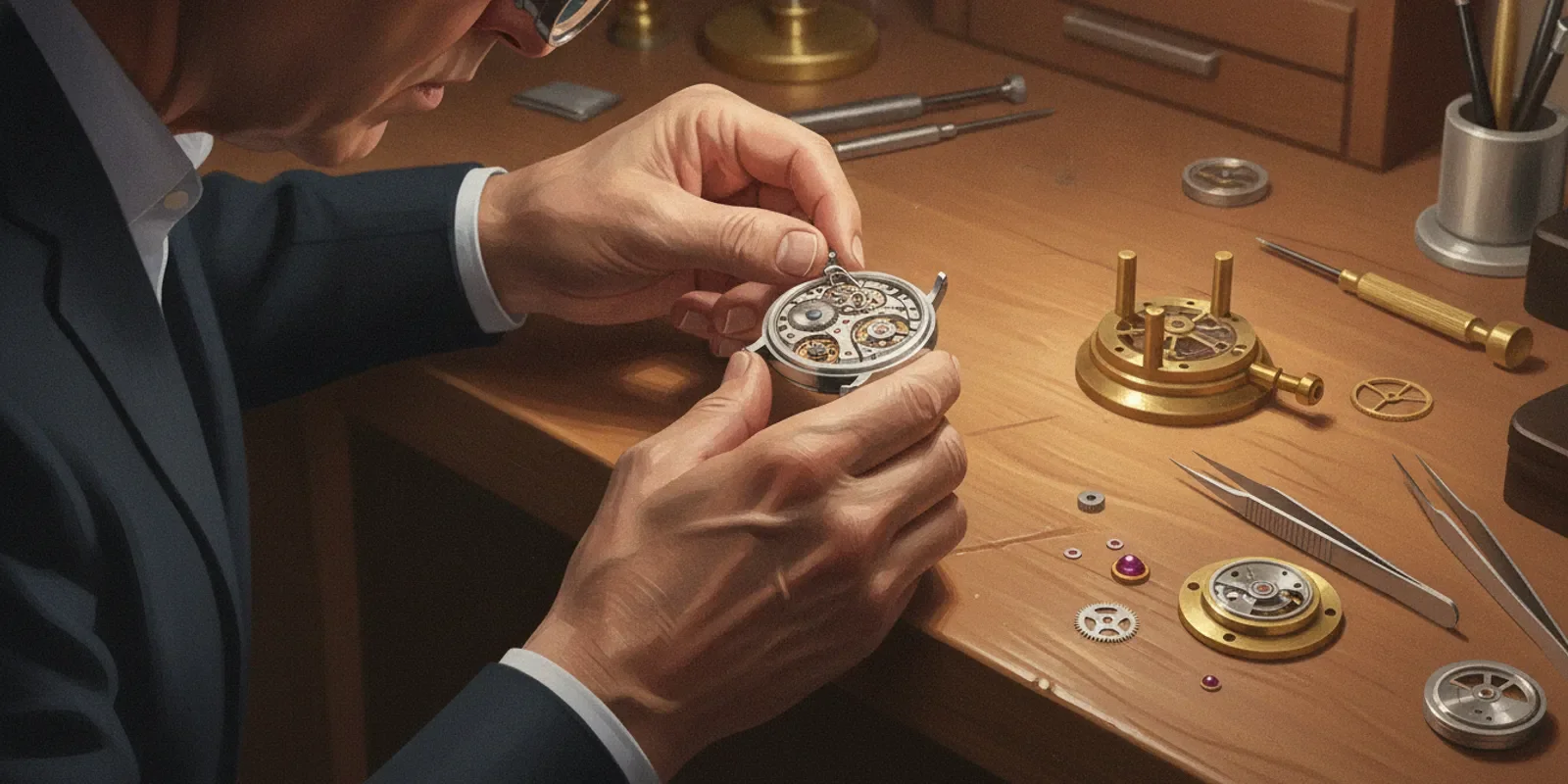
What is an independent watchmaker? The term can describe an individual or a watch business operating outside the ownership and structure of a large luxury-watch group, but it has no single universal definition.
It may refer to independent ownership, creative control, or a small workshop.
For a particular watch, look past the label and ask who designs it, who makes it, how it is finished, and who will service it.
What does “independent watchmaker” mean?
In everyday watch conversation, an independent watchmaker is generally a person or business making, designing, assembling, or servicing watches outside the control of a major watchmaking group. The phrase is used in more than one way. Sometimes it means a small, founder-led brand. Sometimes it refers to an individual craftsperson who builds or repairs watches. It may also describe a separately owned company that works with outside manufacturers and suppliers.
That flexibility makes “independent” a starting point, not a technical certification. No production quantity, movement type, price, or design style automatically makes a watch independent. A maker can produce a small number of highly finished watches using specialist suppliers. Another independent business may make a larger run while retaining its own ownership and product direction. A watchmaker who repairs many brands can be independent in practice without designing watches for sale under a personal name.
Here, independent refers to the business and creative structure behind the watch, not a promise about quality. It does not establish that every part is made in-house, that the watch is hand-built from raw materials, that the company owns a movement factory, or that the watch is rare. Those are separate questions requiring separate evidence.
Does independent mean one watchmaker makes every part?
No. Modern watches depend on specialized components, skills, and suppliers. A small brand may create the concept and design, specify a movement, source a case and dial, then have a specialist partner assemble or regulate the watch. Another may employ watchmakers who handle much of the assembly in its own workshop. Both can be independent businesses, though their production models differ.
“Made by an independent watchmaker” can describe several roles. One person may design the watch, another manufacture its movement, and a third assemble the finished product. The company whose name appears on the dial may be responsible for the overall design while relying on partners for parts or production. That arrangement is not inherently a weakness. The useful question is whether the brand describes those roles accurately and can explain what it does itself.
When a company uses terms such as “in-house,” “hand-assembled,” or “made in” a particular country, ask exactly what those statements apply to. An in-house movement is not the same as an in-house watch. Assembly in a country does not mean every component originated there. A hand-assembled watch can still contain components made by outside specialists.
How does an independent watchmaker differ from a large-group brand?
The difference is often ownership and decision-making. Large watch groups may own several brands, production facilities, distribution networks, or component businesses. An independent brand is not controlled by such a group, or is more directly managed by its owner or founding team. This distinction may influence how a company develops a design, serves customers, or explains its work.
There is no simple quality ladder in which independent always means more original or better and group-owned always means less personal. Large brands can support deep technical expertise, extensive testing, established service networks, and long production histories. Independent brands may have greater freedom to pursue a narrow idea, but they can have fewer resources and a smaller service footprint. Ownership describes structure; it does not settle whether a particular watch suits you.
Ownership: Find out who owns or controls the brand, and whether it identifies itself as privately held, founder-led, or part of a group.
Design decisions: Ask who selected the case, dial, movement, and finishing details, and what the brand contributed creatively.
Production: Determine which steps happen in the company’s workshop and which are completed by suppliers or partners.
Support: Compare the service process, warranty terms, parts access, and likely repair route rather than assuming size guarantees a particular experience.
Some brands change ownership. A name may begin as an independent workshop and later join a group. A group-owned brand may still have a distinct design team and identity. If independence matters to your decision, check current ownership rather than relying on an old article or retailer description.
How is a watchmaker different from a retailer or movement supplier?
A retailer sells watches made by one or more brands. A watchmaker or watch brand is involved in creating, assembling, or servicing watches, though it may also sell directly. These roles can overlap: a business may design a watch and sell through its own website, outside retailers, or both. “Independent retailer” usually describes the seller’s relationship to a retail group or brand network, not the watch’s maker.
A movement supplier makes or supplies the mechanism that powers a watch. Supplying the movement does not necessarily mean the supplier designed the case or dial, assembled the final watch, or owns the brand on its face. Conversely, a brand that uses a supplied movement may still make significant choices about the watch around it. Keep these roles separate when reading product descriptions.
Before buying, identify the seller of record and the party responsible after the sale. Is checkout operated by the brand, an authorized retailer, or a marketplace? Who answers product questions, handles a return request under the stated policy, or receives the watch for warranty service? The designer may not be the company that processes an order or arranges a repair. For a brand selling its own watch, separate its product explanation from its current purchase terms; the purchase channel and the maker’s role need not be identical.
Retailers can provide access to several watches and may have their own service arrangements. Buying directly from a brand can make it easier to hear its account of a design, but direct purchase does not automatically mean faster delivery, better service, or more favorable terms. Read the current conditions for the actual seller and channel.
What does design authorship mean?
Design authorship concerns who shaped the watch’s visual and functional identity. An independent watchmaker may develop a case profile, dial layout, hands, typography, finishing, or complication as part of a coherent design. The maker might create every detail, collaborate with an artist, or work with a specialist designer. A clear account helps distinguish an original concept from a watch that mainly applies a logo or decorative treatment to an existing design.
Ask which elements are original and which are standard components. A movement may come from a supplier while the dial, case, and overall concept are designed for the brand. A familiar movement does not erase the work of designing a watch around it. Conversely, a distinctive dial does not mean the movement or case was developed by the brand. Each part has its own authorship and production story.
Artwork on a dial adds another question: who created it, what collaboration or permission supports its use, and what exactly accompanies the watch? If a companion print is included, check what the seller says about it. Do not assume its dimensions, materials, numbering, or production process unless those details are stated.
Bart Forbes Chrono describes PRO Tour I as a golf-art watch featuring Bart Forbes artwork on the dial and a signed, numbered companion art print. The product identity connects golf imagery, art, and a mechanical timepiece. That offers a concrete authorship example: the artistic element is central, while movement, case, assembly, and service remain separate matters for a buyer to evaluate. A distinctive artistic concept does not answer every technical question. The brand’s PRO Tour I product story is the place to distinguish the artwork and stated product details from broader assumptions about watchmaking independence.
What can production scale tell you?
Independent watchmakers often work at a different scale from the largest companies, but “independent” is not a synonym for “made in tiny quantities.” A watch may be produced in a small run, made to order, released in batches, or offered as a continuing model. A limited-edition statement should specify what is limited: the total number of watches, one dial variant, a time-limited order window, or another defined unit.
Ask how an edition figure is counted. Does it refer to the whole collection or one dial variant? Does the company distinguish planned production from completed and available stock? Are numbered pieces individually identified? Without answers, a number can sound more precise than it is. Do not infer availability, future production, or resale scarcity from “limited” alone.
Scale may influence access to the maker, production time, and parts availability, but those outcomes vary. Small output does not guarantee personal contact, and a larger run does not automatically mean less careful work. Focus on the process and commitments the seller actually describes.
How should you assess finishing and craftsmanship?
Finishing is the quality and consistency of visible and tactile details. Depending on the design, inspect case edges, transitions between polished and brushed surfaces, dial printing, applied markers, hand alignment, crown operation, clasp, strap, and component fit. Mechanical finishing may include movement details, but many are not visible without opening the watch. Photographs can suggest what to examine; they cannot prove hidden workmanship.
Match the finish to the price and purpose rather than comparing every watch with the most elaborate examples in the market. Look at clear images from several angles. If possible, handle the watch or ask for close-ups of areas you care about. Check whether hands and markers align cleanly, edges look consistent, and the strap or bracelet suits the watch’s size and intended use.
For movement claims, find the exact movement designation and ask whether the brand specifies adjustment or testing beyond the movement maker’s standard. “Automatic,” a country label, or a jewel count does not tell you the measured accuracy of an individual watch. If accuracy matters, request the stated tolerance and how it was measured. Do not treat “precision” as a test result without supporting detail.
Use this short inspection sequence:
Check the dial, case sides, back, crown, strap, and clasp in clear images or in person.
Look for consistent edges, clean printing, aligned hands and markers, and secure component fit.
Ask which assembly and finishing steps the brand performs itself.
Compare stated materials, dimensions, origin, water-resistance wording, and accuracy claims across current documents.
Ask what happens if the watch arrives damaged or needs adjustment.
What should you learn about the movement?
The movement is the mechanism that powers and regulates a watch. Mechanical watches may be wound by hand or automatically by wrist motion. Quartz watches use battery-powered electronic timekeeping. Independent brands use a range of movements: some develop their own, some use established supplier movements, and some modify or finish a supplied movement. None of these approaches alone proves that a watch is suitable or unsuitable.
Find out whether the movement name is exact. Ask whether the brand changes it, what those changes involve, and whether qualified service providers can access it. If described as “in-house,” ask what that means in the company’s usage: who designed it, where components are made, and where it is assembled. Clear answers support a fair comparison without vague prestige language.
Consider how you will use the watch. An automatic movement does not need a battery in the usual sense, but it may need winding after it stops and will need maintenance over time. A mechanical watch is not necessarily more accurate or convenient than a quartz watch. Its appeal may lie in its mechanism, wearing ritual, or connection to the design.
Why does service matter when choosing a small maker?
A watch is a long-term object with moving parts, seals, and materials that can wear. Learn how servicing works before buying. Does the company accept watches directly? Does it use a service partner? Can a qualified watchmaker elsewhere service the movement? Are parts and technical information available? Answers may depend on the movement, age of the watch, and repair required.
Read the written warranty. Check its duration, coverage, exclusions, proof-of-purchase requirements, and service request process. Coverage for qualifying manufacturing defects is not the same as coverage for wear, accidental damage, water exposure, or routine maintenance. Look for logistics too: where to send the watch, who pays shipping, and what documents are needed. For PRO Tour I, the published warranty terms describe limited coverage for qualifying defects; review the current wording and process rather than assuming it covers every repair or ownership issue.
Ask about service after the warranty ends. A small company may offer personal communication, but may also rely on a limited number of specialists or an outside supplier. That is not automatically a problem; it is a reason to understand the arrangement. If the seller cannot answer, treat it as an open question rather than filling the gap with assumptions.
Water resistance deserves special care. A rating is not a guarantee for every water situation, and seals can change over time. If specifications conflict between a product page and terms, ask the seller to resolve the discrepancy in writing. Do not infer suitability for swimming or diving from a depth rating; follow current manufacturer guidance for the exact watch.
How do you research a watch before buying?
Research the specific watch and seller, not merely the independent-watch category. A reputation in one area does not verify every product claim. Use current product information, written terms applicable to your purchase, and direct answers about specifications, stock, fulfillment, and service.
Identify the seller. Check the company name shown in checkout and purchase terms. Confirm whether you are buying from the brand, retailer, or marketplace, and who is responsible for the order.
Record the core specifications. Note case dimensions, movement, materials, strap, crystal, water-resistance statement, and included items. Compare the details wherever they appear on the current site.
Separate facts from promotional wording. “Hand-assembled,” “limited,” and “artist-designed” can mean different things. Ask what each claim means instead of treating it as proof of every production step.
Check current purchase conditions. Confirm the live offer and the terms governing payment, shipping, returns, and damaged or defective goods. Do not rely on old dates or cached pages.
Read warranty and service details. Learn what is covered, how service begins, and whether the company can support the movement after warranty coverage ends.
Examine design in context. Decide whether dial, case size, strap, and intended setting work for you. If art or a print is part of the value, verify what is included and how it is described.
Keep the evidence. Save the product description, terms, order confirmation, and written answers as a record of what was represented at purchase.
For an online order, pay special attention to information that may change. Availability, payment arrangements, and delivery estimates are time-sensitive. Confirm the live offer before ordering, and do not assume a delivery date or return option unless it is stated for the current sale. If shopping for PRO Tour I, use the current shop page to check the live offer, then confirm any important term directly in the governing purchase information before completing an order.
How can collectors compare independent watches fairly?
Use the same criteria for each watch rather than comparing one maker’s story with another’s specification sheet. First list your non-negotiables: wrist fit, legibility, movement type, intended use, price, or service access. Then mark which points are confirmed in writing and which need an answer. This is more useful than ranking brands by one label such as “independent,” “in-house,” or “limited edition.”
Design and wearing experience
Consider proportions, weight, strap comfort, and readability as well as the design narrative. If you cannot handle a watch first, study its dimensions and request clear images, while remembering photographs cannot fully reveal comfort or finishing. Think about where you intend to wear it. A bold art dial may be ideal for one collection and less suited to another setting.
Production and movement
Write down the stated movement, what the brand does to it, and which production steps happen in-house or with partners. Compare like with like: an independently designed case paired with a supplier movement is different from a fully developed movement, but neither is an automatic quality verdict. Ask for specifics rather than awarding points for terminology.
Ownership and support
Compare the warranty, repair route, access to parts, seller responsibility, and current purchase terms. A watch with an appealing story may be a poor fit if its servicing arrangement does not meet your needs. Conversely, reliance on outside specialists can be entirely workable when the roles and support route are clearly explained.
Edition and included items
Check what an edition number counts and whether it is confirmed in current writing. Verify any accompanying art, certificate, or documentation. Do not assume a numbered print shares the watch’s number or that a limited production statement predicts future availability or value.
Finally, compare the full ownership picture, not just the displayed price. Review what is included, what the warranty covers, how return or damage claims work, and which details need confirmation. Price alone does not establish value. Account for design, materials, movement, service, and documentation that matter to you.
What does an art-led watch show about independence?
An art-led watch is not automatically independent. The label depends on ownership, control, and the company’s role in development. Still, art-led designs make authorship particularly visible because the image, artist, and dial are central to the experience. Buyers can ask both ordinary production questions and specific questions about the artwork.
Bart Forbes Chrono presents PRO Tour I as a mechanical golf-art watch with Bart Forbes artwork on the dial and a signed, numbered companion print. Its story connects golf imagery to a timepiece; it is not presented as a GPS, shot-tracking, or on-course performance device. Consider the artwork and mechanical object on their own terms, then assess specifications and service separately.
Do not infer endorsement, licensing, or a charitable relationship from an image, tribute, or golf-history reference alone. Read the seller’s exact wording and avoid extending it beyond what is documented. A compelling story adds context but does not replace clear information about what is being sold.
What does independence mean for communication and accountability?
Ownership can affect decisions, but does not guarantee direct access to a founder or a particular level of personal service. A small business may route questions through a customer-care team, distributor, or production partner. A larger company may also provide knowledgeable product support. Look for the actual contact route and response expectations rather than assuming a small operation guarantees one-to-one communication.
Accountability is easier to assess when claims are concrete. A useful product description identifies the movement, gives dimensions and materials, distinguishes the brand’s work from suppliers’ work, and explains applicable sale terms. “Crafted with passion” communicates tone but does not answer a question about adjustment, warranty eligibility, or replacement parts. Ask directly and save the reply with product information.
Check whether answers remain consistent across pages and documents. Differences may arise when information changes, but buyers should not have to guess which version controls. Ask for clarification if a specification, edition statement, payment term, or service promise appears in conflicting forms. If a detail matters to you and you cannot get clarity, pause the decision.
Consider continuity without treating it as a forecast. A newer or smaller company may have a shorter public operating history than an established manufacturer. That does not predict success or future value, but it makes support questions more important. Ask how service requests are handled if the seller is unavailable, whether the movement has support beyond the brand, and what documentation accompanies the watch. Evaluate what is known today.
Is an independent watchmaker right for you?
An independent watch may appeal if you value distinctive design, visible creative authorship, a focused subject, or an approach different from large-scale collections. You may prefer a maker whose story feels personal or whose choices reflect a particular craft or artistic point of view. Those preferences are legitimate, but the label alone should not decide the purchase.
A larger brand may suit you better if you prioritize broad retail presence, established service access, a familiar model range, or a specific technical feature. An independent company may offer greater creative freedom, but its production control and service capacity vary. Neither is a universal answer. Match the watch to your priorities, wrist, budget, habits, and the service arrangement actually offered.
Rank what matters most. One buyer might put design first, then service access, then movement; another might prioritize accuracy, fit, and an established service network. Evaluate each watch against the same questions so a persuasive story or single specification does not overshadow everyday ownership needs.
Frequently Asked Questions
Is an independent watchmaker the same as an independent watch brand?
Not always. A watchmaker can mean an individual who makes or repairs watches, while an independent brand is a business developing or selling watches outside a larger group’s control. A brand may use suppliers, and an individual watchmaker may work independently without selling a personal-branded watch.
Does an independent watchmaker make its own movement?
No. Some develop movements; many use supplier movements or modify an existing design. Ask which movement is used, who makes it, and whether the brand changes it. Movement origin is one part of the production story, not a complete quality measure.
Are independent watches made in small quantities?
Some are, but independent status does not define production volume. Check what an edition figure counts and whether it applies to the whole model or one variation. Do not assume a limited run guarantees scarcity or resale value.
Are independent watches better than watches from large brands?
There is no general answer. Independent status describes ownership or creative structure, not a quality grade. Compare the specific watch’s design, finishing, specifications, service plan, warranty, and seller terms with your needs.
What is most important to check before buying?
Start with current written specifications, purchase terms, warranty, and service process. Resolve unclear or conflicting details before ordering. Those documents help establish what you are buying and what support is available afterward.
Ask a question about the PRO Tour I
Final perspective
An independent watchmaker is best understood through the choices and responsibilities behind a specific watch, not through a label alone. Learn who owns the brand, who shaped the design, how production is divided, what movement and finishing claims mean, and how service works after the sale. That approach lets you appreciate originality while making a clear-eyed decision about the watch you will wear.
