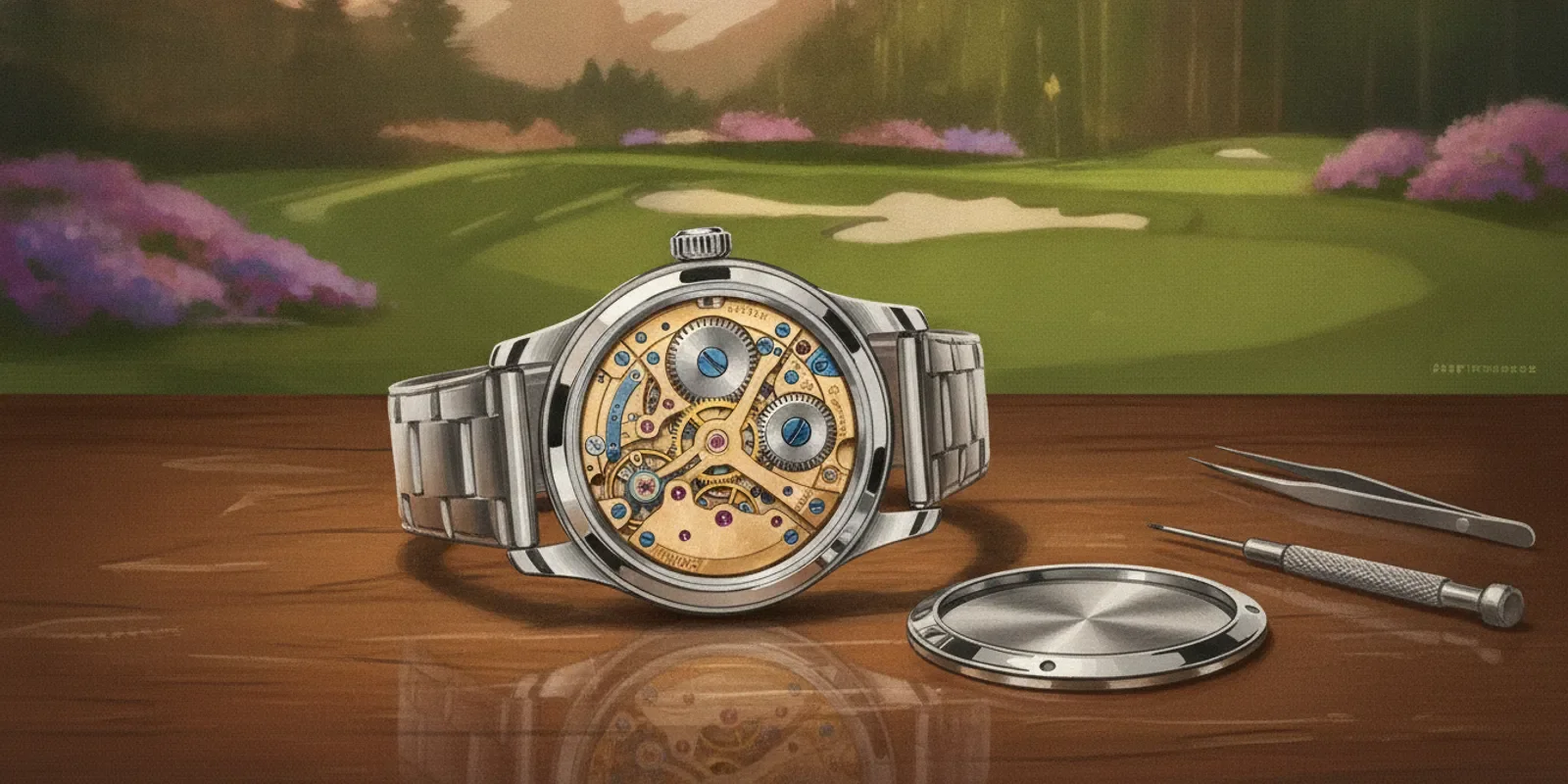
A mechanical watch is a timepiece that uses stored spring energy and a system of moving parts to keep time, rather than relying on a battery to power a quartz oscillator. If you are a golfer or collector asking what is a mechanical watch, the useful answer is not just a list of gears: it is a way to understand how the watch works, what daily ownership involves, and what to check before choosing one.
What does “mechanical watch” mean?
A mechanical watch measures and displays time through a linked mechanical system. Its energy begins in a tightly wound mainspring. As that spring slowly unwinds, it drives gears. A regulating mechanism meters the release of energy into small, repeated steps, and the hands show the resulting passage of time.
“Mechanical” describes how the watch is powered and regulated. It does not, by itself, tell you whether a watch is accurate, easy to maintain, water resistant, handmade, or suitable for a particular activity. Those qualities depend on the movement’s design, construction, adjustment, case and the maker’s published specifications. Two watches can both be mechanical and offer very different experiences.
Mechanical watches are often divided into two winding types: manual and automatic. Both use a mainspring as their source of energy. The difference is how the spring is wound. A manual watch is wound by turning its crown. An automatic watch has a rotor that turns with the movement of the wearer’s wrist and winds the spring through the movement. Many automatic watches can also be wound by hand, but the instructions for a specific model should be checked before doing so.
In everyday conversation, people sometimes use “mechanical” to mean “not battery powered.” That is a useful starting point, but it is not a complete description. A mechanical watch still needs energy, and its parts still need to be in good working condition. The power comes from a spring rather than a battery, and timing is controlled by a physical oscillator and escapement rather than a quartz circuit.
How does a mechanical watch keep time?
The movement is the mechanism inside the watch that stores energy, distributes it, regulates it and transfers it to the display. It helps to follow the energy through the system in order. The exact arrangement varies by movement, but the main jobs are common.
The mainspring stores energy. Winding the crown, or turning the automatic rotor, tightens a long spring inside a barrel. The spring’s tendency to unwind supplies the movement’s power.
The gear train carries that energy. A series of wheels and pinions transmits power from the barrel toward the escapement. The gear ratios also establish the different rotational speeds needed to move the hands.
The escapement releases energy in controlled increments. Rather than letting the mainspring unwind all at once, the escapement repeatedly unlocks and restrains the gear train. This creates the familiar sequence of small movements heard in many mechanical watches.
The balance regulates the rhythm. In a typical wristwatch movement, a balance wheel swings back and forth with the help of a hairspring. Each oscillation helps determine the timing interval at which the escapement releases energy.
The hands display the result. The going train turns the hands at their intended rates. Additional components may drive a seconds hand, date display or other indication, depending on the design.
These parts depend on one another. The mainspring provides power, but power alone does not make a watch keep time. The escapement and balance regulate how that power is used. The gear train carries it. The dial and hands make the result readable. A problem or change in one part of the system can affect how the watch runs.
The movement may be hidden under the dial and case back, but it determines much of the watch’s mechanical character. Some owners enjoy knowing that a small spring and carefully arranged components are doing the work. Others are more interested in the dial, case shape or how the watch feels on the wrist. Either is a reasonable way to choose; the mechanism should serve the wearer’s priorities.
What is the difference between manual and automatic winding?
A manual mechanical watch needs the wearer to wind it at intervals. Turning the crown tightens the mainspring. As the spring unwinds while the watch runs, the wearer winds it again according to the maker’s instructions. The routine can be part of the appeal: winding is a direct interaction with the mechanism. It is also an ownership step to remember.
An automatic mechanical watch uses a weighted rotor that can turn as the wrist moves. The rotor’s movement is transferred to a winding system that tightens the mainspring. This can keep the watch wound while it is worn regularly, depending on the wearer’s activity and the movement. If the watch is left unworn long enough for its stored energy to run down, it will stop and need to be reset and wound before use.
Automatic does not mean that the watch never needs attention. It still needs to be set when necessary, and wrist movement does not guarantee that every wearer will supply enough winding for every movement. A watch winder is not automatically required; whether one is useful depends on the watch, how often it is worn and the owner’s preferences. Follow the manufacturer’s guidance rather than assuming all winding systems behave the same way.
Here is a simple comparison:
Manual: the wearer winds the crown to store energy; the routine is visible and predictable, but it must be remembered.
Automatic: wrist motion can wind the mainspring through a rotor; regular wear may reduce the need for manual winding, but an unworn watch can still stop.
Both: use a mechanical movement and mainspring, and neither should be treated as maintenance-free merely because it has no battery.
When comparing a particular watch, look for the movement type and the maker’s winding instructions. If those details are not clear, ask the seller before purchase. Do not infer winding behavior from the word “automatic” alone, or assume that two automatic movements have the same power reserve or winding system.
How does a mechanical watch differ from a quartz watch?
A quartz watch uses a battery-powered electronic circuit and a quartz crystal to regulate timekeeping. The crystal vibrates at a stable frequency when energized, and the circuit uses those vibrations to control the display. A mechanical watch instead uses the energy in its mainspring and a regulator built from moving parts.
The difference affects use as well as construction. A quartz watch generally needs its battery replaced when depleted. A mechanical watch needs winding, either by hand or through an automatic winding mechanism, and its moving parts require care over time. Both types can be well made, attractive and useful. One category is not automatically the better choice for every person.
Accuracy is also a separate consideration. Quartz watches are commonly chosen when a wearer wants straightforward timekeeping with little daily interaction. Mechanical watches may vary in their rate from day to day. The amount of variation depends on the specific movement, its condition, adjustment, position, temperature and how it is worn. A watch’s being mechanical does not mean it is inaccurate, but the category alone cannot promise a particular rate.
Consider the purpose of the watch. If you need a convenient time display and do not care about winding, a battery-powered option may suit you. If you value the mechanical process, traditional movement architecture or the relationship between a crafted dial and a mechanical display, a mechanical watch may be more engaging. If you are buying for golf, also ask whether you want a timepiece that expresses an interest in the game or an electronic tool with golf functions. These are different jobs.
What does a mechanical watch feel like to own?
Ownership includes small habits. An automatic watch may need winding and setting after it has sat unused. A manually wound watch requires a regular winding routine. Some owners enjoy these steps; others prefer not to think about them. Consider honestly how you want to use the watch rather than choosing only for the romance of the mechanism.
Mechanical watches can have seconds hands that move in a series of small steps instead of the one-second jumps common in many quartz watches. The motion is a visible consequence of the movement’s operation, not a simple quality ranking. Some mechanical designs beat at different rates, so the apparent smoothness can vary. Do not use the seconds hand alone to judge precision or movement quality.
Mechanical movements can also have complications: functions in addition to basic time display, such as a date, chronograph or power-reserve indication. Each additional function brings its own design and operation. Before purchasing, learn how to use each one and whether you will actually value it. A simpler display may be easier to read at a glance, especially when the dial includes artwork or other visual detail.
For a watch with a distinctive dial, look at it from normal viewing distance as well as close up. Check whether the hands are easy to distinguish from the artwork and whether the time remains legible in the settings where you will wear it. A visually interesting dial and a readable dial are not mutually exclusive, but the balance is personal. If possible, view clear photographs and confirm the dial option before ordering.
The case, strap and overall size matter just as much as the mechanism. A watch may have a thoughtful movement and still not feel comfortable on your wrist. Consider the case diameter and thickness, the distance across the lugs, the strap material and how the watch sits under a cuff or alongside sports clothing. A published measurement is a starting point, not a substitute for thinking about your own wrist and habits.
What should you check before buying a mechanical watch?
A useful comparison begins with the watch’s purpose. Are you looking for a daily timepiece, a design object, a mechanical watch to wear occasionally or a particular connection to a sport or artist? Answering that first makes it easier to sort the features that matter from those that merely sound impressive.
Movement type: Confirm whether the watch is manual or automatic. Look for the movement name if provided, and ask what winding and setting steps the maker recommends.
Timekeeping information: Check whether the seller gives a rate specification or adjustment information. Treat a general category label as no guarantee of an individual watch’s performance.
Case dimensions: Compare diameter and thickness with a watch you already find comfortable. If possible, consider lug-to-lug length and how the case shape affects fit.
Dial legibility: Check the contrast between hands, markers and the dial design. Look for clear images at several angles, not only a dramatic promotional view.
Materials and construction: Read the specifications carefully and note which statements are the seller’s published claims. Avoid assuming that a named material or movement proves how a complete watch will perform.
Water-resistance wording: Read the current model-specific specification and its limitations. Do not assume that a mechanical movement makes a watch appropriate for swimming or other water activities.
Warranty and service: Find the actual warranty terms, what conditions qualify, how to request service and whether proof of purchase or authorized service is required.
Purchase and delivery details: Confirm the live price, availability, payment terms, shipping and return rules on the current store page. Do not rely on an old article or archived promotion for current terms.
It is also reasonable to ask what comes with the watch. Some products include a companion item or documentation, but you should confirm what the seller currently states and what is included in the order. Be precise about wording: a signed print, for example, should not be assumed to have a particular material, dimensions or relationship between its number and the watch unless the seller says so.
Look for clear photographs of the actual dial and case details. If the image looks washed out, heavily filtered or inconsistent across pages, ask for a current, well-lit image before deciding. Color can shift between screens and lighting, but readable, accurate product photography helps you understand what the seller is offering.
Finally, separate specifications from interpretation. “Automatic” describes a winding approach. A case measurement is a dimension. A warranty is a set of terms. Phrases such as “collector quality” or “built for every adventure” are not substitutes for evidence about what the watch does. Make your decision using information that answers your own practical questions.
How does a golf-art watch use a mechanical movement?
A golf-art watch combines two distinct ideas: a mechanical timekeeping system and a dial whose design carries golf imagery. The movement does the timekeeping. The artwork gives the watch its visual connection to golf. Understanding that distinction helps a golfer or collector choose it for what it is, rather than expecting functions it was not designed to provide.
Bart Forbes Chrono describes PRO Tour I as a mechanical golf-art watch with a Bart Forbes artwork dial and a signed, numbered companion art print. The company identifies the movement as a Swiss automatic SW200-1 Aig2 and describes the watch as Swiss-made and hand-assembled; these are the seller’s published product claims. The product’s art-led identity is different from a GPS or shot-tracking device. It should not be selected as a substitute for electronic golf functions.
The company lists three versions of Bart Forbes’s The Seasons dial—Spring, Summer and Autumn—and three strap choices: Brown, Black and White. These are choices for one named watch, PRO Tour I, rather than separate product lines. To learn about the design and see current details, visit the PRO Tour I product page. Confirm the current offer and specifications there before making a purchase decision.
A mechanical movement can be part of the product’s character, but it does not tell you whether the artwork is to your taste or whether the watch fits your wrist. Compare the dial options in clear images, consider the case dimensions and strap, and decide whether a mechanical watch suits your routine. If the golf connection matters more to you than watchmaking, start with the visual design and intended use; if the mechanism matters most, examine the movement information and ownership requirements.
The listed case is 42.70 mm in diameter and 12.65 mm thick. Those measurements can help you compare the watch with another case you have worn, but they cannot guarantee a particular fit. The company also lists a 316L stainless-steel case with ceramic components, a sapphire crystal with an inside anti-reflective coating and a leather strap. Treat these as published product details, and check the current product page for the exact configuration and terms.
Do not guess at a water-resistance rating or assume that a golf-themed watch is designed for use in wet conditions. Product information and other terms for this watch have not been consistent on that point. If water exposure matters to you, get the current, model-specific guidance from the seller and follow it. The same careful approach applies to availability, fulfillment and warranty: read the live terms rather than extrapolating from a past statement.
How should you care for a mechanical watch?
Good care starts with the instructions for the particular watch. Winding systems, crowns, seals and complications differ. Follow the maker’s guidance for winding and setting, and do not force a crown or control that feels stuck. If you are uncertain about a setting sequence, pause and ask the seller or an authorized service provider instead of experimenting.
Keep the watch away from avoidable knocks, strong magnetic fields and conditions the maker warns against. These are general precautions, not a promise that every watch responds the same way. A mechanical movement is a collection of small moving parts, and a hard impact or unsuitable environment may affect operation. If the watch stops, runs unusually or is damaged, consult an appropriate service professional.
Wipe the case and strap gently with a clean, soft cloth when needed, while observing the watch’s specific care instructions. Do not immerse a watch simply because a listing uses a water-resistance number. Water resistance is not a blanket guarantee for every activity or for a watch’s entire life; seals and condition matter, and the seller’s current instructions should control.
Mechanical watches may need professional service over time. The schedule depends on the movement, usage, condition and maker’s advice, so avoid applying one universal service interval to every watch. Keep purchase records and warranty information. Before service, ask what work is proposed, who will perform it, whether the provider is authorized under the warranty and what the service terms cover.
For a watch with a leather strap, consider the strap as a wearable material that can respond to moisture, wear and storage. Follow the maker’s care instructions and replace the strap if it becomes uncomfortable or damaged. A strap change should use components and dimensions suited to the case. Avoid tugging at the attachment or improvising tools if you are not comfortable doing the work.
What are common misunderstandings about mechanical watches?
“Mechanical” means perfectly accurate. It does not. A mechanical movement is regulated by moving components and can vary in its rate. Ask for the relevant specification and understand how it applies to the watch being offered.
“Automatic” means it cannot stop. An automatic movement still depends on stored energy. If it is not wound sufficiently, including after a period unworn, it can stop. The wearer may need to wind and set it again.
“More complications always mean a better watch.” A complication adds a function, not an automatic improvement for every owner. Decide whether the feature is useful and whether its display makes the watch easier or harder for you to read.
“A mechanical watch is a sports tool because it is worn during sport.” A mechanical time display is not the same as a sports instrument. Check the actual functions and approved use. A golf-art dial can express an interest in golf without tracking shots, distances or scores.
“One specification answers every practical question.” A movement name, case material or water-resistance statement is only one piece of information. Fit, legibility, service, warranty, current availability and purchase terms each need their own check.
“The mechanism is the only thing worth comparing.” The dial, case proportions, strap, comfort and the seller’s clarity all shape ownership. The right balance depends on what you notice and value when you wear a watch.
What questions should you ask the seller?
If a product page leaves an important detail unclear, ask a focused question and request the answer in writing. For example:
Is this model manual or automatic, and what are the winding and setting instructions?
What movement is currently fitted to the exact configuration I am considering?
What timekeeping information does the seller provide, and how should I interpret it?
What are the case diameter, thickness and other fit measurements?
What is included with the watch, and which details are current for this order?
What are the current price, availability, delivery, warranty and return terms?
What are the maker’s instructions for water exposure, strap care and professional service?
Good questions are specific and practical. If you are mainly interested in golf artwork, ask to see the dial and learn what accompanies the watch. If you are focused on mechanical ownership, ask how winding works and what service guidance is provided. If fit is your priority, compare measurements with a watch you know. These approaches can help you make a choice without relying on general labels.
To see the company’s current path for product information and updates, you can also visit the watch information and waitlist page. Check what the page currently offers; do not assume that a waitlist is a completed purchase or a promise of a particular delivery date.
Frequently asked questions
Does a mechanical watch need a battery?
No. A mechanical watch runs from stored energy in its mainspring. A manual movement is wound by the crown, while an automatic movement can wind through a rotor responding to wrist motion. The watch may still need winding and setting as part of ordinary use.
Do all mechanical watches tick in the same way?
No. The visible seconds-hand motion depends on the movement’s design and operating rate. Some hands appear to move in more noticeable steps than others. That visual effect alone does not establish the watch’s accuracy or overall quality.
Can I wear a mechanical watch while playing golf?
Whether to wear a particular watch during golf depends on its manufacturer’s instructions, construction, fit and your comfort. A golf-art watch is not automatically a golf-performance device. Confirm the watch’s current use guidance and do not infer suitability for impacts, water or other conditions from its theme.
Is an automatic watch maintenance-free?
No. Automatic winding can reduce the need to wind by hand when the watch is worn, but the movement still has moving parts and may require care or professional service. Follow the specific maker’s recommendations and warranty terms.
What is the main reason to choose a mechanical watch?
There is no single reason for everyone. Some people value the mechanical construction and winding ritual; others choose a particular design, story or connection to an interest. Decide whether those qualities fit your preferences and daily routine, then check the actual specifications and terms.
Final perspective
A mechanical watch uses a wound mainspring, gears and a regulating system to turn stored energy into a readable display of time. Knowing the difference between manual and automatic winding, and checking fit, legibility, service guidance and current seller terms, helps you choose with realistic expectations. For a golfer or collector, the best choice is the one whose mechanism, design and everyday use make sense together.
