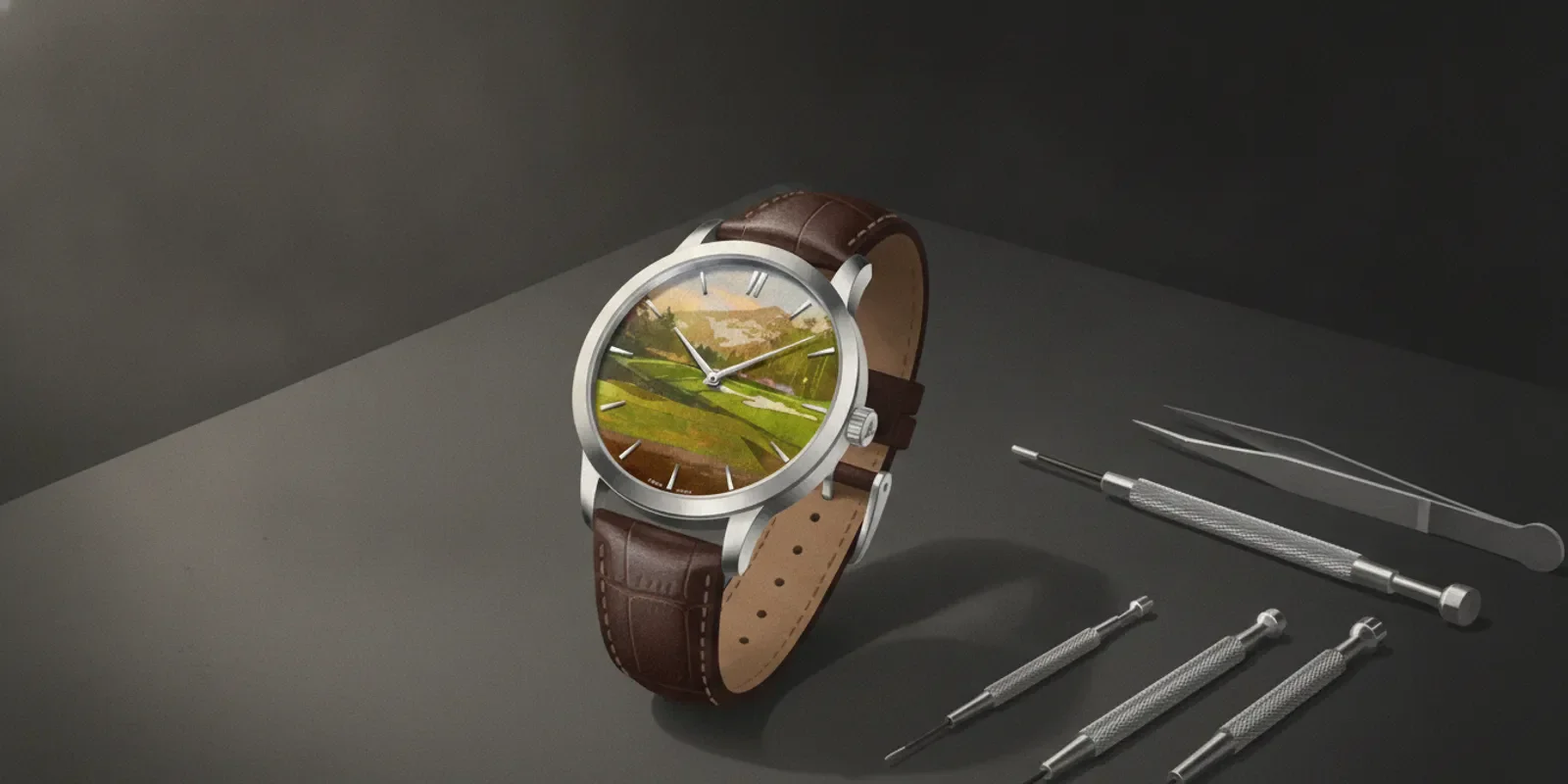
The Sellita SW200 is a Swiss automatic mechanical movement that watch buyers often encounter while comparing everyday watches and collectible designs. If you are researching sellita sw200, the useful question is not only what the calibre is called. It is what that name tells you about the movement, what it does not tell you about the complete watch, and which details you should verify before making a decision.
Ask a question about the watch
What is the Sellita SW200?
The SW200 is a family of Swiss-made automatic mechanical movements produced by Sellita. An automatic movement uses a rotor that moves as the watch is worn. The winding system uses that motion to wind a mainspring, which stores energy and releases it to run the watch. Many configurations can also be wound by hand, but the maker's instructions for the finished watch are the right source for its exact winding and setting procedure.
A calibre is the timekeeping mechanism, not the whole watch. The complete watch also includes its case, dial, hands, crystal, crown, strap or bracelet, and the work involved in assembly and adjustment. Those elements influence how a watch sits on the wrist, how easy it is to read, how it feels to wear, and what kind of care it may need. Two watches described with the same movement family can still differ in important ways.
The letters and numbers in a movement designation are useful identifiers. They give you a starting point for asking focused questions and comparing listings. They do not, on their own, establish the exact configuration installed in a particular watch, an individual watch's accuracy, its water resistance, its warranty, or the seller's service arrangements. Keep those distinctions in view when you read product copy.
What does automatic mean in daily use?
An automatic watch winds as its rotor responds to movement. When the watch is worn, that motion can replenish energy in the mainspring. If the watch is left off the wrist, the stored energy is gradually used and the watch will eventually stop unless it is wound again. That is an ordinary result of a mechanical watch being inactive, not proof by itself that something has gone wrong.
"Self-winding" describes the same basic idea. It does not mean that the watch will keep running indefinitely, never require attention, or remain accurate regardless of how it is worn. A person who rotates among several watches may need to reset an automatic watch after it has stopped. Whether to wind it by hand, and how to do so, depends on the particular watch's instructions.
When you first handle an automatic watch, identify its crown positions and read the supplied directions before setting it. Do not force a crown that resists movement or turn it roughly. If the watch has been unused for a while, use only the procedure recommended by its maker. Ask the seller for plain-language instructions if the paperwork is unclear; guessing is not a useful way to test a mechanical mechanism.
Think of automatic operation as a convenience with a routine, rather than as maintenance-free operation. You still need to store the watch sensibly, avoid impacts, follow care guidance, and seek qualified help if it behaves unexpectedly. A familiar movement name may make research easier, but responsible ownership still depends on the whole watch and its documentation.
What should you check in a movement listing?
Read the movement line carefully and separate confirmed details from broad descriptions. A useful first pass is to record the exact words in the listing, then ask the seller to clarify anything that could change your decision. For example, "automatic movement" gives less specific information than a named calibre, while a named calibre still may not describe every variation or adjustment in the finished watch.
Exact designation: Does the listing identify an SW200, a particular SW200 variant, or a longer configuration name? Copy it exactly into your notes instead of shortening it from memory.
Source of the claim: Is the movement information stated by the watch's maker or seller? Can the seller confirm that it applies to the exact model and version you are considering?
Configuration and changes: Does the listing describe customization, finishing, or adjustments? If those matter to you, ask what the terms mean for the specific watch rather than assuming that all watches sharing a calibre name are finished alike.
Operating instructions: Are winding, setting, and storage directions included? Ask how to get a copy if they are not readily available.
Timekeeping statement: Is an accuracy figure provided for the calibre or for the assembled watch? Find out whether it is a stated tolerance, a measured result, and what conditions apply.
Ownership support: Who answers service questions, what warranty terms apply, and what service channel should an owner use?
These questions are useful whether you are considering a new purchase, examining a pre-owned listing, or comparing watches that use related movements. Keep the listing and any written answers. If an important feature cannot be substantiated, mark it as unknown rather than filling the gap with a general claim about a movement family.
What does the movement name not tell you?
A calibre designation is not a complete performance report. It does not establish how a particular watch was regulated, how it behaves in different positions, when it was last serviced, or what condition it is in today. It also does not identify all the design decisions made by the watch brand. Those questions concern the individual watch and the people who assemble, adjust, sell, and support it.
The name also does not tell you the case dimensions, dial layout, materials, strap quality, legibility, or comfort. A watch can have a movement that interests you and still be too large, thick, heavy, or visually busy for your preferences. Conversely, a watch that suits your wrist and purpose may be appealing for reasons that have little to do with its calibre.
Nor does the movement alone establish the watch's water resistance. That is a claim about the completed watch and its construction and condition. A movement designation is not a substitute for a specific, consistent rating and clear use guidance from the seller. If a listing gives conflicting figures or leaves the question unclear, ask before exposing the watch to water. Do not infer that it is suitable for swimming or diving.
Finally, a movement name does not establish who made the complete watch, where every component originated, what its warranty covers, or whether service will be convenient. Terms such as "Swiss movement," "Swiss-made," and "assembled in Switzerland" should be read in their exact context. Ask what a claim applies to if origin matters to you, and avoid treating one component's designation as proof about every part.
Does an SW200 tell you how accurate a watch is?
No single movement name can tell you the real-world rate of an individual watch. Timekeeping can depend on the specific example, its adjustment, how it is positioned, its state of wind, use, age, and service condition. A manufacturer or seller may state a tolerance or publish a result, but first identify exactly what is being described. A general specification for a calibre and a measured result for one completed watch are not interchangeable statements.
If a listing gives an accuracy figure, ask three practical questions: Is this a specification or an observation? Does it apply to the movement in general or this watch individually? Under what conditions and over what period was it assessed? A number without that context can sound more conclusive than it is. Do not turn a stated range into a personal guarantee unless the seller's written terms explicitly make that promise.
For a watch you already own, observe its behavior over a reasonable period and follow its instructions. A brief check or phone application may offer a rough observation, but it is not necessarily a diagnosis. If the watch runs noticeably differently than expected, stops repeatedly, or changes after an impact, make a note of what happened and contact an appropriately qualified watchmaker or the seller's service channel.
Avoid opening the case to inspect the movement unless you have the proper training and tools. Opening a case can damage parts or affect seals, and it is not a reliable shortcut for confirming a performance claim. A professional can examine the watch using suitable equipment and explain whether adjustment, service, or another step is appropriate.
How can you compare two watches using the SW200?
Use the movement as one line in a full-product comparison. It may be a meaningful part of your choice, but it cannot answer every question about fit, design, ownership, or value to you. A simple written comparison helps keep each claim attached to the right product rather than allowing a familiar calibre name to dominate the decision.
Purpose: Decide whether the watch is for regular wear, a collection, a particular visual theme, or a mix of those things. Intended use shapes which features matter most.
Dimensions and fit: Compare case diameter and thickness, and look for lug-to-lug measurements if the maker supplies them. Check strap width and material too. Numbers and wrist try-ons are more useful than vague descriptions such as "wears small."
Reading the dial: Consider contrast, hand shape, marker visibility, and whether the dial is easy to read in the light where you expect to use it. A highly detailed artwork dial may prioritize imagery and character rather than a spare, high-contrast layout.
Materials and construction: Note the stated case, crystal, crown, and strap materials. Keep the source of each statement clear, and distinguish a listed specification from independent testing.
Movement details: Record the exact calibre wording and any stated adjustment or finish. Ask what is specific to the completed watch.
Warranty and service: Read who is responsible for a claim, what is covered, what exclusions apply, and which service route is required.
Purchase terms: Verify the current price, availability, payment and fulfillment terms with the seller. Do not rely on old page text or assume that a past offer remains in force.
Imagine two listings that both name an SW200. One might provide clear dimensions, care instructions, warranty language, and a point of contact; the other might give only the movement name. The first gives you more evidence with which to make a decision, even before you decide which design you prefer. That is not a claim that one watch is technically superior; it is a reminder to assess the quality and completeness of the information available to you.
Now imagine the movement is your top priority but the case dimensions are not listed. Do not assume the watch will fit because the movement is familiar. Ask for measurements, compare them with a watch you already wear comfortably, and consider thickness and lug-to-lug length as well as diameter. If you cannot try the watch on, those measurements help you make a more informed estimate, though they cannot perfectly reproduce the feel on your wrist.
What is the difference between a movement and a complete watch?
The movement is the mechanism that keeps time inside the case. The complete watch combines that mechanism with the visible design, housing, crystal, controls, strap or bracelet, and the maker's assembly and finishing choices. A movement may come from a specialist manufacturer and be used by a separate watch brand. As a result, the movement maker and the maker or seller of the completed watch may have different roles.
That distinction matters when a listing uses broad origin or craftsmanship language. Ask whether the description concerns the movement, its assembly, the complete watch, or a particular component. A phrase about one part should not be stretched into a statement about every part of the product. If you need a precise answer, ask for the wording and documentation that apply to the exact model.
It also matters for service. A movement platform's name may be useful to a watchmaker, but a service decision can involve the completed watch's construction, parts, seals, and warranty conditions. Before buying, find out where to direct a future question and whether the seller specifies an authorized service route. Do not assume that the movement name alone tells you the service process or the cost of future work.
How does the SW200 relate to the PRO Tour I?
Bart Forbes Chrono describes the PRO Tour I as a golf-art collectible in mechanical-watch form. The company's product information identifies a Swiss automatic SW200-1 Aig2 movement and describes the watch as hand-assembled in Switzerland. These are seller-published product claims, not an independent test or certification. The watch's central idea is its golf artwork by painter Bart Forbes on the dial, accompanied by a signed, numbered art print; the movement is one component of the complete offering.
If you want to see how the seller presents the movement alongside the rest of the product, review the PRO Tour I product information. Check the exact movement wording there and ask the seller to confirm any point that affects your decision. Do not treat the designation itself as evidence of a specific accuracy result, service interval, or performance under every condition.
The distinction between movement and watch is particularly useful here because the PRO Tour I is an art-led design. The dial's golf imagery and the companion print are part of the offer's character; they are different questions from what calibre is installed. If you are drawn to the artwork, consider whether the dial remains readable for you and whether the dimensions and strap suit your wrist. If you are comparing technical details, request clear answers about the completed watch rather than relying on its artistic description.
The company's published specifications describe a 42.70 mm 316L stainless-steel case with ceramic components, a thickness of 12.65 mm, a sapphire crystal with an inside anti-reflective coating, and a leather strap. Treat these as the seller's claims and verify the current product information. Dimensions can help you anticipate fit, while an on-wrist try-on, if available, gives a better sense of how the case feels. Neither the movement designation nor the artwork replaces those checks.
It is also important to match the product to the job you want it to do. The PRO Tour I is not a GPS, shot-tracking, or on-course performance watch. It is presented as a mechanical watch featuring golf art. Someone seeking course mapping or game metrics should evaluate a product designed for those functions separately; a golf theme on a dial does not imply digital golf features.
How should you check a product page before buying?
Read the page once for the story and a second time for the facts. On the first pass, notice what draws you to the watch: movement, artwork, materials, proportions, or the overall concept. On the second, make a short checklist of information that should be clear before purchase. This prevents appealing photography or a technical name from distracting you from practical questions.
Capture the product identity. Record the model name, movement wording, dial and strap options, and any version details. If a name appears in more than one form across the page, ask which wording applies.
Check dimensions against your wrist. Compare the listed diameter and thickness with a watch you know. Look for lug-to-lug and strap width if comfort or replacement straps matter. Ask for missing measurements rather than guessing.
Separate claims by subject. Mark which statements describe the movement and which describe the case, dial, materials, assembly, or service. This is especially important when one listing combines technical and artistic language.
Find the ownership terms. Locate the current warranty and service information. Note what proof is needed, where a claim goes, and any restrictions. Do not infer a change-of-mind return policy from a warranty statement.
Resolve unclear specifications. Ask about any detail that conflicts or lacks enough context, including water-resistance wording. Do not choose the more reassuring of two inconsistent statements without confirmation.
Confirm current transaction details. Verify price, stock, payment, and fulfillment directly with the seller. A page or archived statement may not reflect current terms.
For example, a collector who cares most about the dial may first check whether the artwork and strap options are shown clearly, then confirm the dimensions and the presentation of the companion print. A buyer focused on mechanical ownership may start with the exact calibre, winding instructions, stated accuracy information, and service route. Both approaches are reasonable. The point is to turn interest into a set of answerable questions rather than expecting a movement label to answer them all.
Keep a record of what you asked and the answers received. If you later compare a second watch, use the same checklist for both. Consistency makes it easier to distinguish a real difference from a difference in how two sellers write their product pages. It also helps you notice when a specification is missing rather than silently assuming that one product matches another.
What care does an automatic watch need?
Use the care instructions supplied for the particular watch. Keep the crown and controls in the positions described by its maker, and handle them gently. If you are unsure how to wind or set the watch, ask for the correct steps. Do not force a crown that feels stuck or unusual. These simple habits are safer than improvising a procedure from advice written for a different model.
Protect the watch from impacts and from conditions beyond its stated use. Do not assume that a movement's reputation establishes the water resistance of the assembled case. Water resistance relates to the complete watch and its seals, and condition or service can matter. If the rating is unclear or conflicting, ask the seller and err on the side of caution. Do not infer suitability for swimming or diving from a movement designation.
Mechanical watches can also be affected by strong magnetic fields. If a watch starts behaving unusually after exposure to a magnet or electronic equipment, ask a qualified service provider to assess it. Do not use a strong magnet as a test. A professional can advise whether demagnetization or another kind of attention is appropriate for the watch.
Service timing should follow guidance for the specific watch and its condition. A blanket interval offered without regard to the model, use, and history is not a substitute for the maker's advice. Keep purchase documentation and warranty information in a safe place. If the watch needs attention, describe what you observed and use the service route specified by the seller instead of attempting repairs yourself.
What questions should you ask the seller?
A concise, specific inquiry is more likely to produce useful answers than a broad request for reassurance. You can ask:
Which exact SW200 configuration is installed, and is that specification documented for this model?
Does the movement description refer to the calibre generally or to the configuration in this completed watch?
Is an accuracy tolerance or measured result available, and what does it apply to?
What instructions are supplied for winding, setting, storage, and care?
Who handles service questions, and which provider or route should an owner use?
What does the current warranty cover, what is excluded, and what steps are required for a claim?
Are the current price, availability, payment terms, and fulfillment details confirmed?
Can you clarify any specification that appears inconsistent, especially a rating or material description?
Ask in writing when the answer affects your purchase. A written reply provides a useful record of what was confirmed and what remains uncertain. If a response relies on a technical phrase you do not understand, ask for an explanation in plain language. A good buying decision does not require you to pretend to understand every calibre term; it requires you to know which facts matter and whether they have been answered.
What are common misconceptions about the Sellita SW200?
"The movement name guarantees a certain accuracy." It does not establish the performance of an individual watch. Ask what accuracy information applies to that finished watch and under what conditions.
"Every watch with this calibre is the same." The movement designation does not determine the case, dial, materials, assembly, adjustment, warranty, or service experience.
"Automatic means no winding or care." An automatic watch uses motion to wind and may stop when left unworn. Follow the maker's instructions for operation and care.
"A Swiss movement proves the origin of the entire watch." A movement description does not, on its own, establish the origin of every component or the completed watch.
"The calibre determines water resistance." Water resistance is a claim about the complete watch and its condition. Verify the watch's own rating and use guidance.
"A familiar calibre guarantees effortless service." Service arrangements depend on the seller, construction, warranty, and provider. Confirm the process in advance.
These corrections do not make the calibre name unimportant. It gives you a concrete starting point for research and a precise subject for questions. The mistake is to mistake that starting point for a complete technical evaluation or a promise about the entire watch.
For the PRO Tour I, keep both parts of the decision in view: the company identifies the movement as a Swiss automatic SW200-1 Aig2, and it presents the watch as a golf-art collectible with a signed, numbered companion print. Those details speak to different aspects of the product. Consider the movement, design, fit, documented terms, and your own reasons for collecting as separate but related parts of the choice.
Explore the PRO Tour I product information
Frequently Asked Questions
Is the Sellita SW200 automatic?
Yes. The SW200 is an automatic mechanical movement family. For the exact winding and setting procedure, use the instructions for the completed watch.
Does an SW200 watch need a battery?
An automatic mechanical movement stores energy mechanically in a mainspring rather than using a battery to power timekeeping like a quartz movement. Check the watch's documentation for its exact configuration and operating instructions.
Can I compare two watches using the SW200 name alone?
No. Use the calibre as one comparison point, then assess the full specifications, dimensions, materials, fit, warranty, service support, and seller documentation.
Does the SW200 tell me whether a watch can go in water?
No. Water resistance is a specification of the completed watch, and its condition matters. Confirm the specific watch's stated rating and recommended use instead of inferring water suitability from its movement.
Is the PRO Tour I a golf GPS watch?
No. Bart Forbes Chrono presents it as a golf-art mechanical watch, not as a GPS, shot-tracking, or on-course performance device.
Final perspective
The Sellita SW200 is useful information when you evaluate a mechanical watch, but it is only one part of the decision. Confirm the exact configuration, the claims that apply to the finished watch, its fit and care instructions, and the current warranty and purchase terms. Then decide whether the complete watch suits your priorities, rather than choosing on the movement name alone.
