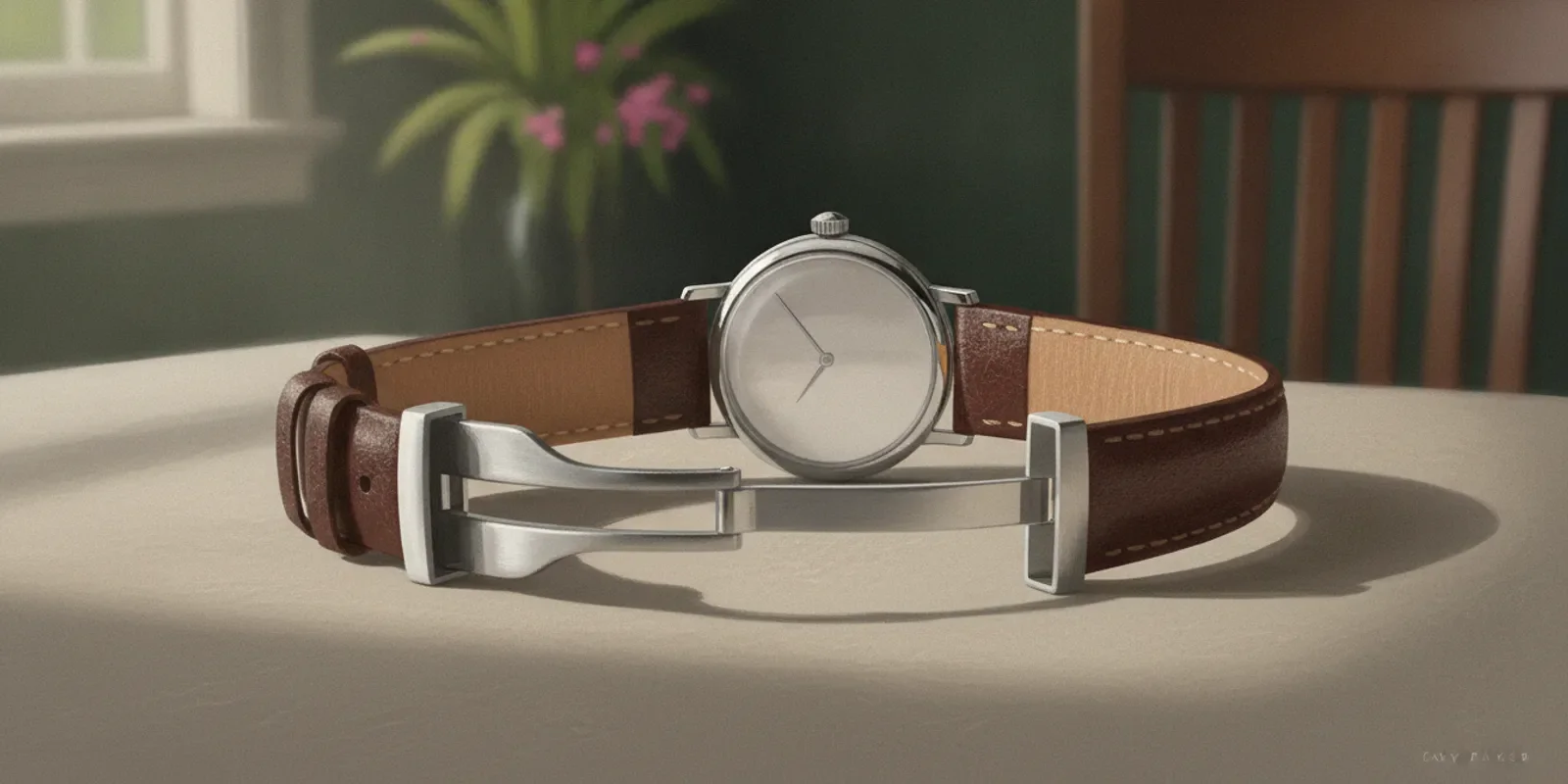
Watch clasp types influence how a watch fastens, feels under the wrist, and can be adjusted. For a golfer or collector, the useful question is not which clasp name sounds best; it is whether the actual closure suits the strap, fits your wrist, and can be operated confidently. This guide compares the common designs and gives you a practical inspection method.
What is a watch clasp?
A clasp is the part that joins the two ends of a strap or bracelet around your wrist. Some closures use a pin through a hole. Others fold one or more hinged arms together. A metal bracelet may have a folding plate, while a leather strap may use a buckle or a deployant mechanism. These names describe broad forms, not a guarantee of a particular safety lock, adjustment range, material, or level of security.
It helps to separate three related questions. First, how does the closure open and close? Second, how is the strap or bracelet sized? Third, how does the whole watch feel when worn? A clasp can be easy to use but uncomfortable if the bracelet is too tight. A well-fitted strap can still be inconvenient if its release mechanism is difficult for you to operate. Assess all three rather than choosing on terminology alone.
Also distinguish the clasp from the attachment between the strap and the watch case. Spring bars or another attachment system connect the strap to the lugs; they are not the wrist closure. If you change a strap, a correct clasp does not prove that its case attachment is seated properly. Keep the full assembly in mind when checking a watch before wear.
What are the common watch clasp types?
Tang buckle
A tang buckle works like a belt buckle. The strap tail passes through a frame, and a metal pin (the tang) enters one of the strap holes. Keeper loops hold the remaining tail in place. This straightforward design appears on many leather, rubber, and fabric straps.
Its main advantage is familiar operation and clear fit choices: move the tang to another hole to loosen or tighten the strap. The practical compromise is that the strap bends around the buckle and at the selected hole, so repeated flexing can leave marks over time. That is a wear consideration, not proof that the strap is defective. When fastening, avoid pulling the strap sharply or forcing the tang through a hole that is too small.
To check one, inspect the buckle frame, pin, hole edges, and keeper loops. The tang should sit in a hole without slipping out, and the strap tail should remain contained. Try fastening it with the watch supported over a soft surface. If you struggle to reach the buckle or manage the strap tail, repeat the test slowly rather than assuming you will get used to it immediately.
Single-fold or single-deployant clasp
A single-fold clasp has a hinged arm that folds in one direction, securing the strap without the wearer repeatedly threading its tail through a buckle. Some versions include a cover or safety catch; others have a simpler release. The exact construction depends on the watch and strap, so the name alone does not establish what features are present.
This style can be convenient if you prefer a repeatable fastening action. It may also reduce how much the strap must bend at one point each time the watch is put on or removed. Still, the clasp needs a correctly sized strap. If too long, the folded hardware may sit awkwardly or press against the wrist. If too short, it may pull the watch too tightly or make closing difficult.
Learn the order of operation before wearing it out: identify any button, lift point, or safety cover, and determine which direction the arm folds. Close it without forcing it, then check that it is fully seated. If the watch has a safety element, confirm that it is engaged. A clasp that seems closed but is not latched should not be treated as secure.
Butterfly or double-fold clasp
A butterfly clasp opens into two hinged sections, one extending from each side of the center. When closed, the arms fold beneath the strap. From above, the strap may appear to have a relatively uninterrupted line. Butterfly mechanisms are used with some leather straps and some bracelet designs.
The two-sided folding action can distribute the hardware across the underside of the wrist. Some wearers like the balanced feel; others find the mechanism thick or notice its edges. The only reliable way to judge that is to try the actual watch, especially while bending the wrist. A clasp that looks elegant in a product photograph can still create a pressure point on a particular wrist.
Ask how the strap is sized. A buckle strap may have several holes, while a deployant setup may use a different set of positions or require a different strap length. Do not assume that every butterfly clasp offers fine, quick adjustment. Check both the initial sizing method and whether small changes can be made later.
Folding clasp on a metal bracelet
Metal bracelets commonly use hinged plates that fold and latch. The closure may have a simple fold-over action, an additional cover, buttons, or another locking feature. The details vary by maker and model. Bracelet sizing is a separate issue: links may need to be removed, and some clasps provide small position changes after the main sizing is complete.
Open and close the clasp as intended, without bending the plates or using a tool unless the maker says to. It should close evenly and sit flat. If the bracelet includes a secondary lock, learn how it engages. A positive feel is helpful, but do not test security by yanking hard on the watch. Instead, inspect the latch visually and move the wrist normally after fastening.
Fit matters just as much as the mechanism. A loose bracelet may slide toward the hand and rotate the dial; one that is too tight may press into the skin. If adjustment requires removing links, ask about the right tool or a watch professional rather than improvising with household objects that could scratch the bracelet or damage pins.
Hidden or jewelry clasp
A hidden clasp is designed to blend into the bracelet, concealing much of the closure when the watch is on the wrist. It can suit someone who wants a continuous bracelet appearance. Its release may be less obvious than a visible buckle, however, so practice locating the correct press or lift point before wearing the watch in a situation where you need to remove it quickly.
Check the closure from the underside and identify how the two sides meet. Close it fully and look for any gap or misalignment. A concealed release is an aesthetic feature; it is not evidence by itself that the clasp is more secure or better made. If you cannot tell whether it has engaged, ask the seller to demonstrate the action or provide clear open and closed views.
Hook-and-loop and other specialty closures
Some fabric or sport straps use hook-and-loop material, while other designs use sliding or proprietary closures. These are not interchangeable with a folding bracelet clasp, and their care or adjustment may differ. A hook-and-loop strap can be repositioned across a continuous area rather than a set of buckle holes, but the user should inspect the material for wear and follow care instructions.
For a less common design, avoid guessing based on a photograph. Find the maker’s instructions and learn how the closure releases, what parts are replaceable, and how its adjustment works. The more unusual the mechanism, the more useful a short hands-on demonstration becomes.
How should you compare clasp designs?
| Closure | Typical pairing | How it fastens | Practical check |
|---|---|---|---|
| Tang buckle | Leather, rubber, or fabric strap | Pin enters a strap hole | Check hole fit, tail retention, and ease of reaching the buckle |
| Single-fold | Some straps and bracelets | One hinged arm folds shut | Learn the release and check any safety catch |
| Butterfly | Some leather straps or bracelets | Two hinged arms fold inward | Assess underside thickness and sizing options |
| Bracelet folding clasp | Metal bracelet | Hinged plates fold and latch | Confirm bracelet length, latch alignment, and adjustment method |
| Hidden clasp | Linked bracelet | Concealed parts join the bracelet ends | Locate the release and verify full engagement |
| Hook-and-loop or specialty | Selected fabric or sport straps | Material overlap or a model-specific mechanism | Review maker instructions and wear condition |
Use the table as a first-pass comparison, then verify the specific watch. “Common use” is not an absolute rule: manufacturers may pair a closure with different strap materials, and product configurations can vary.
Consider the table’s final column as a set of questions, not a score. One wearer may prioritize quick removal; another may care more about a clean appearance or a wide adjustment range. A useful comparison records what you can observe on the actual watch and leaves unknown details as questions for the seller.
How do you choose a clasp for comfort?
Start with the wrist and strap, then consider the closure. Put the watch on at the position where you normally wear it. The case should not slide around freely, and the strap should not feel as though it is pinching. The clasp should sit where it does not dig into the wrist crease or create a hard pressure point when your hand bends.
Fasten it at a sensible starting position. For a buckle, choose a hole that holds the watch without compressing the wrist. For a bracelet, begin with a fit adjusted by the appropriate method rather than forcing a link or latch.
Move through ordinary positions. Bend your wrist forward and back, rotate your forearm, and let your hand hang naturally. Notice if the clasp edge catches or if the watch shifts in a way that distracts you.
Check the case and closure together. A large case can change how the watch rests; the clasp is only one part of that contact. If the closure lands directly on a sensitive spot, see whether the strap orientation or fit can be adjusted safely.
Test fastening with your usual hand. Put the watch on and remove it as you normally would. If you need both hands, unusual finger strength, or repeated attempts, decide whether that is acceptable for routine use.
Recheck after a short wear period. A fit that feels fine for a moment may become uncomfortable as your wrist warms or moves. Reassess before a long day rather than waiting until the closure irritates you.
Small fit changes can make a difference. A buckle often gives discrete positions through its holes. A bracelet may need link changes for the main fit and may have smaller adjustments at the clasp. If a watch is between settings, do not assume that a clasp modification is appropriate: ask what adjustment range is designed into that model.
Consider a simple try-on log when comparing two watches. Note the strap type, closure, adjustment position, comfort at rest, comfort when bending, and ease of removing it. For example, a buckle may feel comfortable at the desk but require more dexterity to fasten. A bracelet may be easy to close but feel bulky underneath. Writing down the distinction helps separate a preference from a sizing problem.
What should a golfer consider?
Golf involves changing grip pressure, rotating the forearms, and moving the wrists through a broad range. That does not mean a particular clasp is automatically suitable for play, or that any closure protects a watch from impact. Think about comfort and secure fastening during your own ordinary movement, and follow the manufacturer’s guidance about intended use.
Try a few golf-like motions while wearing the watch: hold a club as you normally would, take a slow practice swing without a ball, and check whether the clasp presses against the underside of the wrist. Do not use an expensive watch as a test object around a club or other hard equipment. The purpose is to notice discomfort and movement, not to prove impact resistance.
Different setups lead to different trade-offs. A tang buckle makes it easy to change among its holes, but a strap tail or buckle may be noticeable if it sits where your wrist flexes. A folding clasp can provide repeatable fastening, but folded hardware may feel prominent underneath. A metal bracelet can feel stable when correctly fitted, while its size may require link adjustment before it is comfortable. None of these general tendencies can replace trying the actual watch.
If the watch is mainly for the clubhouse, collecting, or everyday wear, choose for those uses rather than assuming it must be worn during every round. If you do wear it while practicing, make sure it does not interfere with your grip and do not treat the closure as protection against knocks. For a golf-art watch, the visual connection to the sport may be the point; the practical question remains whether the particular strap and clasp suit your routine.
How can you inspect clasp security and condition?
Security depends on correct sizing, sound components, and full engagement. A name such as “deployant” or “fold-over” does not tell you the condition of a used clasp or whether a particular latch is functioning. Before regular wear, learn what a normal closing action feels and looks like.
Inspect visible hinges, pins, buttons, and latch surfaces for looseness, bending, or damage.
Close the mechanism fully and check that the parts align. Engage any safety lock provided on that design.
Move your wrist normally and confirm that the closure remains in place; do not pull hard on the watch as a stress test.
Check the strap holes, keeper, or bracelet links as well as the clasp. The whole assembly carries the watch.
After a strap change, confirm that the case attachment is correctly seated before wearing it.
If the closure feels newly loose, will not latch, or needs excessive force, stop wearing the watch and have it checked.
For a new watch, follow the supplied care and operating instructions. For a pre-owned watch, ask whether the clasp is original to the model, whether it has been repaired, and whether the strap or bracelet has been altered. These are practical condition questions, not reasons to assume that age alone makes a closure unsafe.
How do sizing and adjustment work?
Adjustment is one of the most important buying questions because it determines whether the clasp can be comfortable on your wrist. Strap holes give a limited set of positions. Bracelet links allow larger changes in length; some clasps may also offer smaller positions. Other mechanisms use a slider or a proprietary arrangement. A photograph rarely shows the full range.
Before buying, establish who can make the adjustment, what tools are needed, and whether the strap or bracelet can be changed without damaging it. Ask whether extra bracelet links are included if the listing or seller can confirm that detail. Do not assume any particular item is included unless the seller states it. If adjustment will be performed by a professional, clarify whether the watch must be brought in or sent somewhere and how the item should be handled.
For a bracelet, a good adjustment is not simply “tight” or “loose.” The watch should stay in a comfortable position while allowing normal wrist movement. For a strap, the selected hole should hold the case steady without making the strap edge press into the skin. If no available position feels right, ask whether a different strap length or adjustment is supported instead of forcing the closure.
What should you ask before buying a watch?
When a listing does not show the underside or explain the mechanism, ask concise, model-specific questions. This is especially useful when ordering remotely, because broad descriptions do not confirm the actual hardware in the selected configuration.
What exact closure is fitted to the strap or bracelet I am considering?
Can you provide clear photographs of it both open and closed?
Does it use a safety catch, push buttons, a hidden release, or another mechanism?
How is the fit adjusted, and what range is available?
Can the strap be replaced, and which compatible options are confirmed?
Does any sizing or adjustment require a tool or professional help?
What should I do if the closure becomes difficult to operate or no longer stays shut?
Keep notes so you can compare answers across watches. If you are considering the Bart Forbes Chrono PRO Tour I, the seller describes it as a Swiss automatic watch featuring golf artwork and a companion signed, numbered print. Those are seller descriptions of the offer. Review the current model information and confirm the specific strap and closure details rather than inferring them from general clasp terminology.
You can review the PRO Tour I details while making that checklist. The product information is a useful place to identify the watch, but if the clasp, fit, or adjustment method is not explicit, ask for clarification before treating it as confirmed.
How should you compare two watches with different closures?
Use the same test for each candidate, otherwise small differences in fit and operating sequence are easy to overlook. Record the material, closure type, adjustment method, number or range of fit positions if stated, and any safety feature you can actually verify. Mark unknown information as unknown rather than filling it with assumptions.
Set the use case. Decide whether the watch will be worn daily, occasionally, during golf-related activity, or mainly as part of a collection. The expected routine changes what matters most.
Test the action. Open and close each clasp several times. Notice whether it requires a specific sequence, careful finger placement, or more force than feels reasonable.
Assess fit independently. If one watch is too loose, do not blame the closure until you know whether it can be resized. Compare comfort only after each has been adjusted appropriately.
Check the underside. Note thickness, edges, and where the hardware contacts your wrist. A hidden clasp can look seamless from above while still having a substantial underside.
Review maintenance and replacement. Ask how the mechanism should be cleaned or serviced and whether the strap or closure is replaceable, when those details matter to you.
Make a decision from priorities. Choose the option that best matches your comfort, operation, and appearance preferences, not the one with the most elaborate name.
A worked comparison helps. Imagine Watch A has a leather strap and tang buckle, while Watch B has a bracelet with a folding clasp. A is easier to adjust by moving the pin among holes, but the strap tail and buckle are part of the fastening routine. B avoids threading a tail each time, yet its bracelet may need link sizing and its underside may feel thicker. If both fit comfortably, the decision may come down to which operating action you prefer and whether you value the bracelet or strap feel more.
Now consider a second case: two watches use a deployant-style closure, but one has a single folding arm and the other a butterfly mechanism. It would be a mistake to treat them as identical. Compare their release points, how much hardware sits beneath the wrist, how the strap is sized, and whether small adjustments are possible. The label narrows the question; hands-on details answer it.
What common clasp mistakes should you avoid?
Avoid treating the clasp as a small detail that can be ignored until after purchase. It is part of fit and daily operation. The following mistakes are easy to prevent:
Assuming all clasps with the same name are identical. Construction and release steps differ among makers and models.
Equating complexity with security. Extra hinges or covers do not prove a closure is safer; proper engagement and condition matter.
Judging comfort from a photograph. A photo cannot show how the hardware feels against your wrist or whether the fit is right.
Ignoring adjustment costs or effort. Link changes or specialist mechanisms may require tools or assistance.
Forcing a stiff clasp. Excess pressure can damage parts; find the intended release and seek help if it remains difficult.
Confusing clasp security with water suitability or impact resistance. Closure type alone does not establish either property.
These checks are particularly useful when comparing a collector’s watch with a watch designed around another use. A mechanical closure is only one component. The watch’s stated specifications and instructions, not the clasp, answer questions about other forms of use.
Frequently Asked Questions
Which watch clasp is easiest to use?
It depends on your dexterity and preference. A tang buckle has a familiar pin-and-hole action, while a folding clasp may feel convenient once you learn its release sequence. Try the actual closure and consider whether you can operate it comfortably with your usual hand.
Is a deployant clasp automatically more secure than a buckle?
No. The label does not establish the quality, condition, fit, or correct closure of a particular mechanism. A well-fitted buckle or folding clasp can both be suitable when operated as intended.
Can every clasp be adjusted without tools?
No. A buckle may offer hole positions, while bracelets often need link changes and some clasps have model-specific adjustment systems. Confirm the method for the exact watch before buying.
Does a clasp affect comfort?
Yes. Thickness, edges, location, strap length, and bracelet fit can all affect comfort. Try the watch through ordinary wrist movement and look for pinching or pressure points.
Should I wear a watch while playing golf?
That is a personal decision guided by comfort and the manufacturer’s stated use instructions. A clasp does not protect a watch from impact. If you wear one during golf-related movement, make sure it is fitted securely and does not interfere with your grip.
Visit the watch information page
Final perspective
The best clasp is the one that matches the strap, fits your wrist, and is easy for you to operate correctly. Compare the actual mechanism, adjustment method, and underside comfort, then test the closure through ordinary movement before relying on it day to day.
